
Ukraine Recovery Conference in Rome: how the government chose which communities would go to Italy – and why there was confusion

In July, Italy will host the next Ukraine Recovery Conference (URC). Not every community has the chance to attend — the number of places is limited, and the final decision on who goes is essentially made by the government. This is the fourth such conference, and for local governments, participation is an opportunity to attract additional investments and implement important projects. To compete for the right to travel to Rome, communities had to publish announcements in the DREAM system by May 5.
The main focus was not only on whether a community had an investment project but also on whether it had an updated development strategy. There were only 100 slots available, while nearly 300 communities applied — three applicants for each available place.

Information on the community selection process for URC, as provided by the Ministry for Communities and Territories Development
A mayor from one of the selected communities, speaking anonymously to avoid jeopardizing the selection results, shared how the evaluation process unfolded:
The 100 available places were supposed to be distributed as follows: 40 frontline communities, 30 from central Ukraine, and 30 from the west. Currently, about 45 communities have the same score, so the final number may rise to 145. However, each community will then likely be allowed only one representative, instead of two as initially planned. This would allow more communities to attend.How were the applications evaluated? A single community could submit multiple projects, each of which was assessed by the ministry. A maximum of 2 points could be awarded per project. Submitting multiple projects gave communities a better chance of scoring higher. But project points weren’t the only factor. International partners were also involved in scoring, though it’s unclear how — not every region received their evaluation. In some areas, partners gave scores, in others, they didn’t. Military administrations were supposed to provide scores as well — and they did. Additionally, professional associations, including the Association of Ukrainian Cities, were expected to give points. I noticed some associations didn’t score us, so I contacted their leadership directly.
On June 12, the Association of Ukrainian Cities published a statement denying involvement in the evaluation process:
The Ministry for Communities Development did not provide the Association of Ukrainian Cities with the list of communities that applied to participate in the conference and independently carried out the ‘evaluation and ranking’ process without involving the Association.
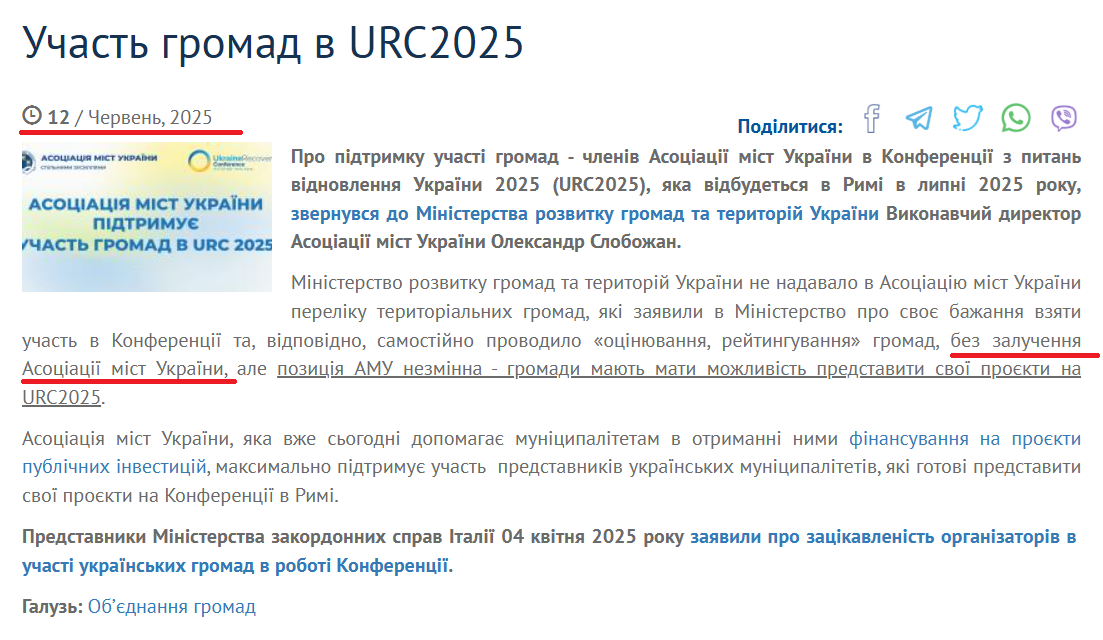
Screenshot from the Association of Ukrainian Cities website – June 12, 2025
What happened? The Association of Ukrainian Cities and other associations received letters asking them to submit a list of 30 communities by May 7. However, these letters did not clearly explain that this was part of a scoring system aligned with the selection methodology. At the time, the ministry hadn’t yet identified which communities had submitted projects and which needed to be evaluated.
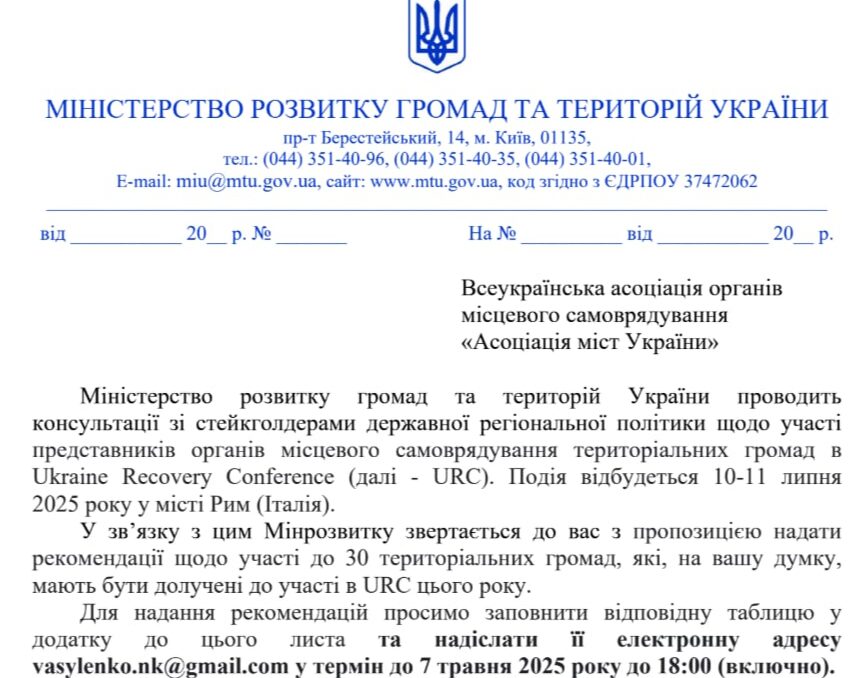
Excerpt from the Ministry’s letter to the Association of Ukrainian Cities
In response, the Association submitted a list of several dozen communities — specifically those with sister-city partnerships with Italian municipalities.
The same day the Association released its statement denying involvement in the evaluation process, the Ministry published an announcement asserting that the selection was “transparent, based on clear and publicly defined criteria.” These criteria appeared retroactively, and association recommendations were counted as additional points.

Screenshot from the Ministry for Communities and Territories Development website
Questions were also raised about the involvement of military administrations. In the Kyiv region — which drew international attention during the occupation of Irpin and Bucha — the regional military administration officially did not score any communities. Yet one community, Petrivska (Vyshhorod District), had points listed. This was revealed in a restricted-access ranking table reviewed by the public initiative “Holka” while preparing this article.
Despite this, 13 communities from the Kyiv region will attend the conference: Buchanska, Brodyanska, Brovarska, Boyarska, Baryshivska, Vasylkivska, Kalynivska, Myronivska, Obukhivska, Pirnivska, Slavutychska, Chabanivska, and Nemishaivska.
It’s important to note that the original announcement on the Ministry’s website did not mention any role for military administrations or associations in the evaluation process.
International partners also played a role in the evaluation. These included the British and Slovenian embassies, UNICEF, U-LEAD, and UN-Habitat. However, each organization operates in a limited set of regions — their areas of priority — which limits their capacity to evaluate all communities.

At least 150 communities will attend. We increased the quota by 1.5 times and reached an agreement with the Italian side. Each community will have one representative. We understand there may have been questions about the methodology, and next year we’ll take our experience into account. I believe we should create a working group so that all stakeholders can assess the community projects and understand that their evaluations matter.
Regarding the participation of civil society organizations, Riabikin added that several ministries provided recommendations on who should attend the conference. The Ministry for Communities recommended certain associations and the DREAM team, while the Ministry of Economy and the Ministry of Foreign Affairs gave their own suggestions regarding civil society participants.
For next year, it’s important not only to revise the current methodology but also to ensure that the new one is preliminarily reviewed by organizations with relevant expertise. This methodology must be made publicly available before the start of the selection process to minimize misunderstandings like those that occurred this year.
Specially for Channel 24