
“Computer doesn’t take bribes”? What is the government slipping us in the construction industry…

Scandalous urban planning reform: If not through the door, then through the window
The government may soon consider a draft resolution that clones the unsigned urban planning reform initiated by the President. This document was published on December 13, and the author is identified as a namesake of an individual close to former Opposition Bloc MP Dmytro Isaenko.
The draft resolution surfaced officially after a loud scandal erupted when it became known through the media that it could be considered by a vote on the eve of the European Council meeting in Brussels. There, discussions on Ukraine’s accession to the EU were eventually approved. Voting on the mentioned resolution could have provided opponents of Ukraine’s European integration with additional arguments and negatively impacted the situation at a crucial moment.
The urban planning reform is a bill proposed by the leader of the “Servant of the People” party, Olena Shuliak (5655), which the Verkhovna Rada endorsed a year ago and has been criticized by our international partners, including the European Parliament and the European Commission.
Deputy Prime Ministers Oleksandr Kubrakov and Mykhailo Fedorov, who also serves as the Minister of Digital Transformation, consistently emphasized to Western partners that thanks to the digitization and automation outlined in Bill 5655, corruption would supposedly be overcome.
Considering that the government may openly violate the law and essentially implement controversial provisions through the aforementioned draft resolution, it is important to clarify the true nature of the “digitization” and “automation” envisioned by the authors of the reform.
Digitization SV An Attempt to Undermine Democratic Tools?
A year ago, when the project was being prepared for the second reading, the public was not allowed to participate in the Zoom meeting of the relevant committee, now headed by Olena Shuliak, and their suggestions were not taken into account. The transcripts of these secret meetings have still not been published. Thus, the proponents of “digitization” do not intend to use it to allow citizens access to information and influence on policy formation regarding reconstruction.
However, the party “People’s Power” obtained one of the two transcripts from sources. It became clear that parliamentarians were essentially asked to support a “pig in a poke,” which even angered members of the “Servant of the People.”
“How am I supposed to vote?.. How can you comment on the fact that at 7 pm you only sent these tables, and today it’s Monday, 4 pm, and when were we supposed to do this – two thousand pages? I mean, I don’t know, I can’t speed read, as they say,” stated Oleksandr Kachura (“Servant of the People”) during the discussion.
Nevertheless, the initiative was supported in parliament, with decisive votes coming from the Opposition Bloc.
On the same day, citizens gathered enough signatures for a petition to the president to veto Bill 5655. At that time, it was a record-fast collection. But the lobbyists of the controversial project were determined: they not only created a unique website pro5655.gov.ua on a government domain but also held a series of implementation meetings with the public sector. However, at these meetings, the supporters of 5655 sat in the hall with Kubrakov, while the public was relegated to a “contact zoo” on Zoom. Digitization in action.
In the government, Kubrakov, along with his deputy Natalia Kozlovska, were not the only ones supporting this reform. Minister of Digital Transformation Mykhailo Fedorov was also actively advocating for the bill, mentioning the TAPAS USAID project, which also publicly supported digitalization in 5655.
Moreover, to convince Western partners, even the Speaker of the Verkhovna Rada Ruslan Stefanchuk was involved.
“We are launching new services that will destroy corruption. In addition, the head of the Verkhovna Rada and relevant ministries appealed to the European Parliament. The goal is to jointly discuss Bill 5655 and define a roadmap for changes that will make the construction sector more transparent,” wrote Fedorov.
Indeed, as Fedorov mentioned, TAPAS officially stated on its website that it supports digitization in this bill.
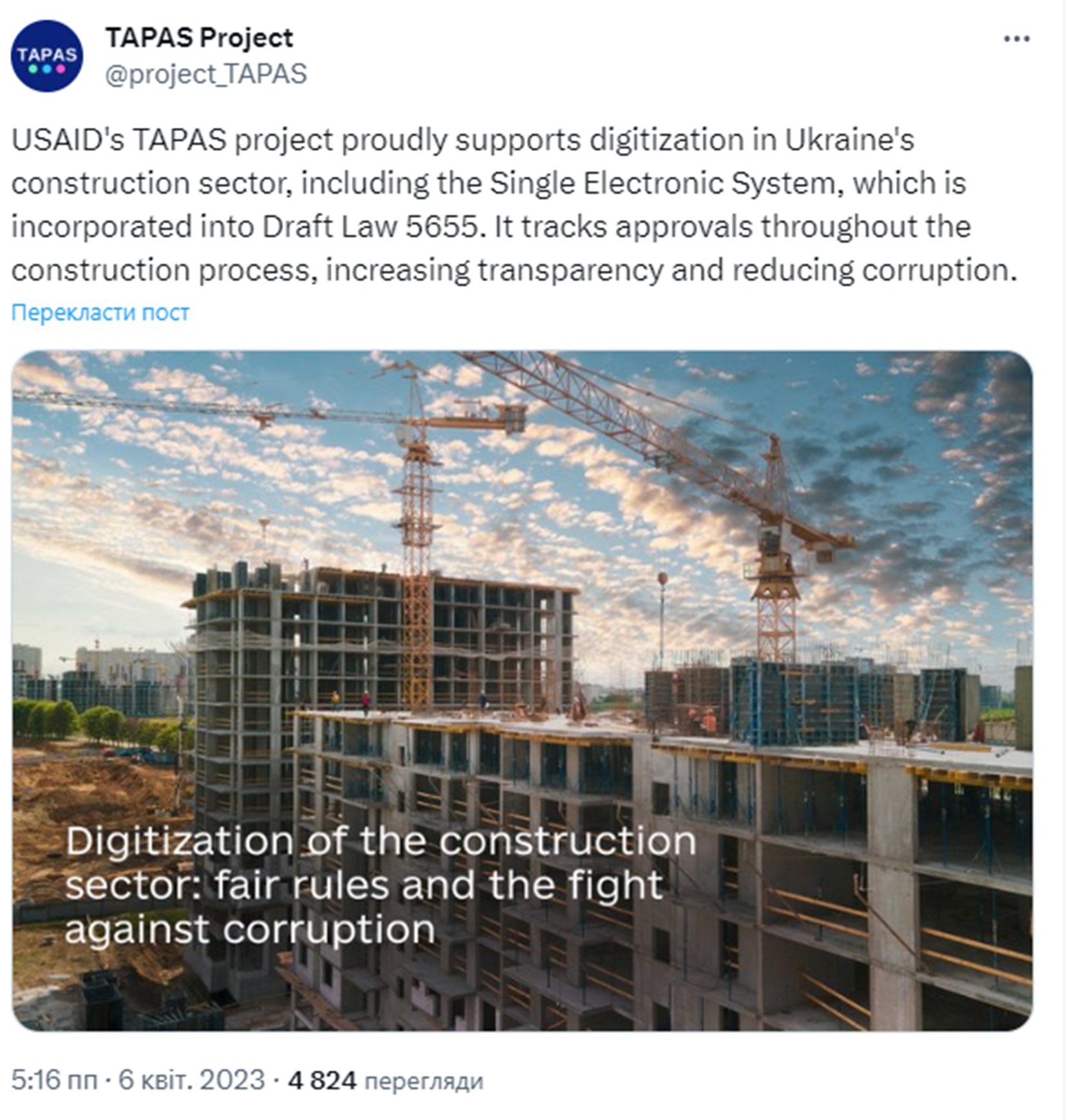
Screenshot from Twitter TAPAS Project
Regarding inquiries about bill 5655, TAPAS has not yet responded. They only clarified why we need the names of experts who prepared the organization’s public stance and whether it’s possible to review the text before it’s published, which contradicts journalistic standards. Should a comment be received, the organization’s position will definitely be published.
TAPAS’s positive feedback about 5655 was actively used by both Kubrakov and Shulyak in shaping the media field, suggesting that international partners greenlight this reform.
Kubrakov himself stated, “We worked on this together with the USAID/UKaid project Transparency and Accountability in Public Administration TAPAS.”
Ultimately, following Stefanchuk’s letter and government communications, a meeting with international partners took place. However, when the public sector tried to join a meeting with European colleagues to explain the risks of 5655, at one such event, representatives of civil organizations and even Member of Parliament Hanna Bondar from “Servant of the People” were simply disconnected from Zoom after a few minutes. This is how digitalization is used to block opponents.
However, there were no problems with accessing this meeting on Zoom for the Minister of Digital Transformation Fedorov, who emphasized his support for 5655.
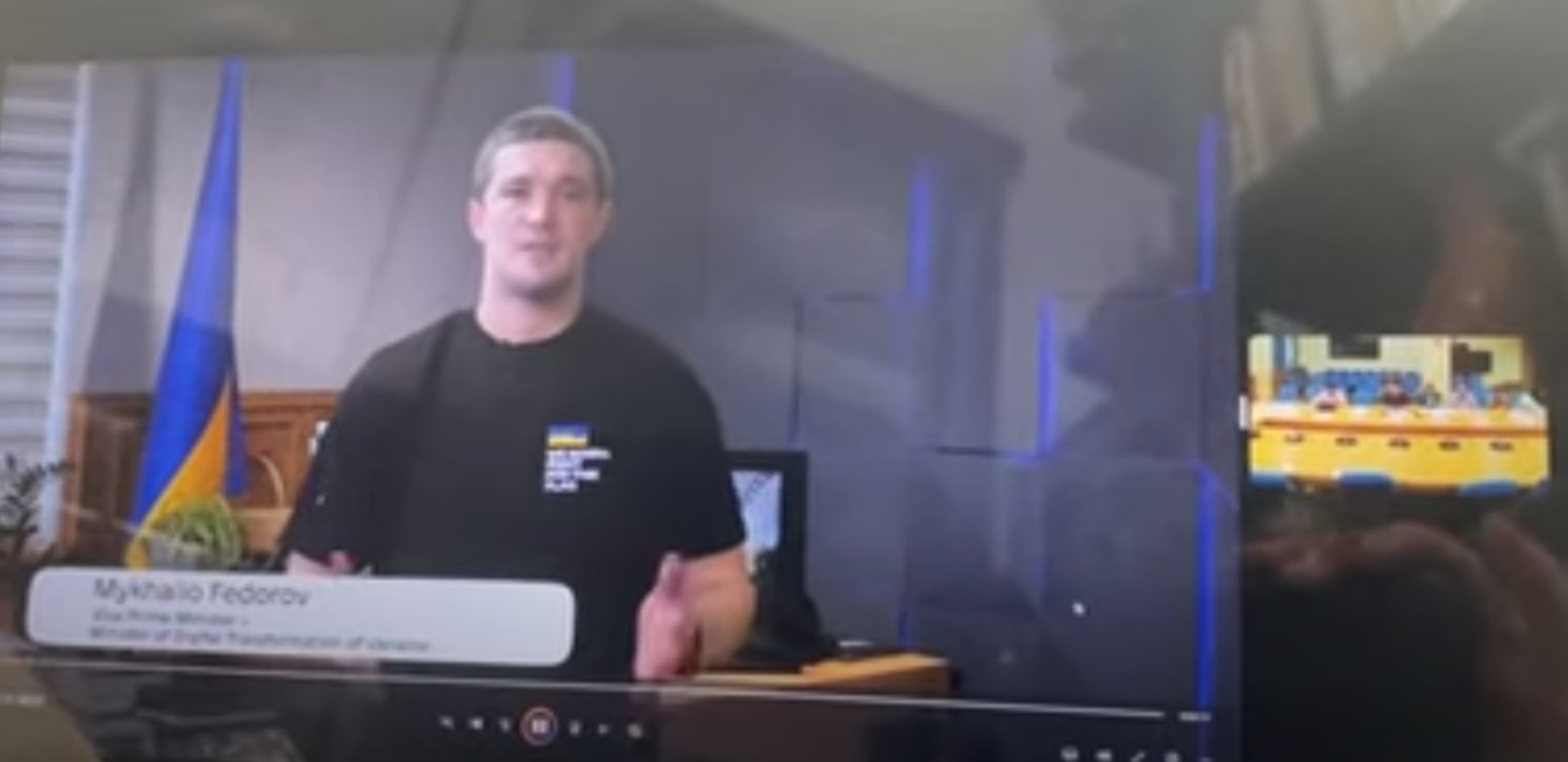
Screenshot from the video of Deputy Prime Minister Mykhailo Fedorov’s speech
Besides digitalization and digitization, lobbyists of the reform have repeatedly praised automation, claiming that it will eliminate illegal construction.
‘You know, a computer doesn’t take bribes,’ emphasized Shulyak.
But is what the main author and government officials are talking about actually in the bill? This year, we managed to analyze these two thousand pages of the bill and understand what kind of traps were laid under ‘digitalization’ and ‘digitization’ by those who presented it as one of the key achievements.
Computers Instead of Corrupt Officials?
When we talk about construction, the very basis for corruption is the urban planning conditions and restrictions. They are issued by local self-government bodies in manual mode, and local officials calmly write in there whatever the developer’s heart desires.
Of course, this problem needs to be addressed because corruption at the local level does as much damage as corruption at the central level. Olena Shulyak repeatedly emphasized that there will be automation and a fight against corruption in local authorities. However, the bill passed in the second reading still envisages the issuance of such documents manually at the local level (Article 29, and subsequent articles of the Law of Ukraine ‘On Regulation of Urban Development Activity’).
Three years ago, Ukraine launched a system that has completely digitized and made public the entire process of granting construction permits. This system is called the Unified State Electronic System in the Construction Sector.
In Shulyak’s initiative №5655, the word ‘automation’ or its root derivatives are used many times. But in reality, it’s not actually about automation. Therefore, the slogan ‘a computer doesn’t take bribes‘ is not about simple computer checks, but about decision-making by the computer. So what happens with the data from the automatic check?
For example, here’s a thesis that was incorporated into the bill: ‘automatically, by means of the electronic system, a protocol of automatic verification is generated.’ The word ‘automatically’ appears twice here, but into the already mentioned electronic system, one needs to enter: land documents, architect’s certificate, etc. No matter how many violations are embedded in the construction project, the system is supposed to detect them all automatically, but will only block the submission of such a project in one case – if the height of the building is violated. All other violations will be recorded, but there will be no reaction.
What kind of violations could these be? It could be violations of heritage conservation requirements that threaten cultural heritage, or violations of urban planning documentation that should reflect the interests of the community. If it is a small construction project (CC1 — the official class of responsibility for small constructions) and the computer detects the aforementioned violations, the architect who submits this documentation can manually check that there are no violations and the computer is mistaken.
As for large projects (CC2, CC3 – classes of responsibility for large constructions), the project undergoes further examination by experts hired by the developer. This expertise can be private. The procedures for this examination are determined by the norms of the article proposed by the urban development reform (Article 31-3). Here, the term ‘automation’ is used even more: “automatically, by means of the electronic system, a protocol of automatic verification is generated, which includes information specified in the protocol of automatic verification of construction project documentation.”
If violations are detected during automatic verification, the registration of the expertise in the system is blocked only in two cases: when there is a lack of a package of documents with relevant approvals or if the dismantling of a monument or a newly discovered object of cultural heritage is envisaged. However, it is not certain that this electronic system will have information about all objects of cultural heritage. At least, not all of them are there now, and it has been a year since the Verkhovna Rada supported bill 5655 in the second reading.
For all other violations, the expert hired by the developer for large projects does the same as the architect for small projects – marks that all remarks can be ignored. And no one verifies what is written.
Next, the construction client submits an application for state registration of the right to carry out construction work, indicating the project and expertise numbers that were previously ‘automatically checked‘ (Articles 35 and 36 of the Law ‘On Regulation of Urban Development Activity’).
As easily guessed, the application is automatically processed by automatic analysis for making an automatic decision for which an automatic verification protocol is automatically generated.
But the grounds for automatic refusal are the same – to avoid demolishing the monument and to have a complete package of necessary documents.
This is the courteous automation in 5655 – the ‘notorious’ computer automatically checks a pile of construction parameters, automatically detects various violations, and then automatically registers the right to construction with automatically identified violations because any architect or expert has the right to manually check that the computer is wrong and there are no violations.
Equally interesting ‘automation’ is envisaged during the commissioning of facilities. During the commissioning of buildings, it is crucial to comply with all norms. To prevent a situation like the earthquake-damaged buildings in Turkey, where the state absolved itself of control and implemented a series of building amnesties.

Consequences of the earthquake in Turkey, photo Anadolu agency
In Ukraine, lobbyists of urban development “reform” grant developers the right to hire private oversight. This means that the state also agrees to relinquish safety matters during construction to private hands.
Currently, if a developer violates the project, they cannot put the building into operation until a new project passes examination. However, according to the proposed law 5655, examination is required only if the height is violated. Even then, the oversight architect can check a box stating that violating the project is acceptable (Article 371).
It is clear that no “automation” will verify the quality of the constructed building.
The term “automation” is also substituted in the final stage when the developer needs state registration confirming that the object has been accepted for operation. In reality, nothing changes here. Previously, the inspector also signed everything in the electronic system.
Someone might argue that thanks to 5655, some automation is introduced, and even if it’s not enough, at least some violations will be automatically blocked.
However, this is not the case. Automatic checks and blocking of documents with violations have already been provided for by existing legislation since the summer of 2021, but they are detailed at the level of the Regulation of the electronic system, approved by Cabinet Resolution No. 681, in particular, points 28-36. The list of violations that allow automatic blocking by developers is much broader than what 5655 proposes.
Therefore, the urban development reform authored by Deputy Shulyak, compared to existing legislation, reduces the number of violations automatically blocked upon detection, leading to an increase in the role of manual checks and the influence of human factors. This represents a kind of negative “automation.”
Hence, there are questions primarily for the Deputy Prime Minister Fedorov and TAPAS, who were supposed to ensure the automation of these processes and convinced the public for a year that they had succeeded in this task. Questions for Fedorov are not only about “automation” or “digitization” but also about why he personally lobbied for a bill that, as indicated by our international partners, is unacceptable due to corruption risks.
The Ministry of Culture proposed creating a working group when considering 5655, but it did not happen. Acting Minister of Culture Rostislav Karandeyev emphasizes that the government resolution was developed without involving the professional community of heritage conservationists and the relevant ministry: “Therefore, the project contains inconsistencies with current heritage conservation legislation and norms that pose risks to the preservation of Ukrainian cultural heritage. The Ministry of Culture advocates for minimizing the subjective human factor in making management decisions. However, the ‘automation’ of processes in the field of cultural heritage should not deprive heritage objects of their unique history. The draft resolution is published for public discussion, so now experts and the public have the opportunity to submit their proposals. After the completion of public discussion, the draft resolution will be submitted to the Ministry of Culture for approval. We will promptly provide our expert opinion, as we already have specific proposals and comments.”
If the government goes ahead to implement through a resolution the norms of an unsigned bill, it will be a violation of the law, says MP Hanna Bondar (Servant of the People): “The role of local self-government and the public cannot be diminished. It seems that the Ministry of Infrastructure is playing a game of blind man’s buff: will the Eurocommission close its eyes to the government resolution? Legislative defects are also serious. There are at least three violations of Article 92 of the Constitution, which states that such norms should be determined by law, not a government resolution. Also, this document contradicts the ‘Procedure for conducting an experimental project to increase the efficiency of organizing the planning processes of the Cabinet of Ministers of Ukraine,’ referred to by the law that established the possibility of implementing experimental procedures.”
This is why it is crucial to monitor the upcoming government meetings and see if Prime Minister Denis Shmyhal will present the draft resolution.
Specially for “Glavkom“