
“The Kolomoisky Group” and the Monster Resort in the Carpathians: How Yanukovych’s Old Schemes Are Reviving Thanks to the “Ihor Mazepa Law”

Last week in the Verkhovna Rada, lawmakers managed to block a harmful amendment that would have allowed the construction of wind turbines in the Carpathians without an environmental impact assessment. The attempt to amend the law fell short by just one vote, meaning the effort to change it could resurface.
However, wind turbines are not the only threat to the mountains. As across Ukraine, in the Carpathians, land can be illegally allocated for construction. This already happened at the Krachuneska meadow on the slopes of the Svydovets range, where developers close to oligarch Ihor Kolomoisky attempted to build a “monster resort” with the support of local authorities. The Supreme Court’s decision stopped this project, but it sparked information campaigns against the defenders of the Carpathian forests, led by MP Oleksandr Dubinsky.
Despite the court ruling, Krachuneska Meadow, located near Dragobrat, still faces the threat of development. The local Hutsul shepherds, who currently graze livestock there and produce the famous Carpathian cheese called “vurdu,” are unaware that they are doing so on land that could be taken from them at any moment.
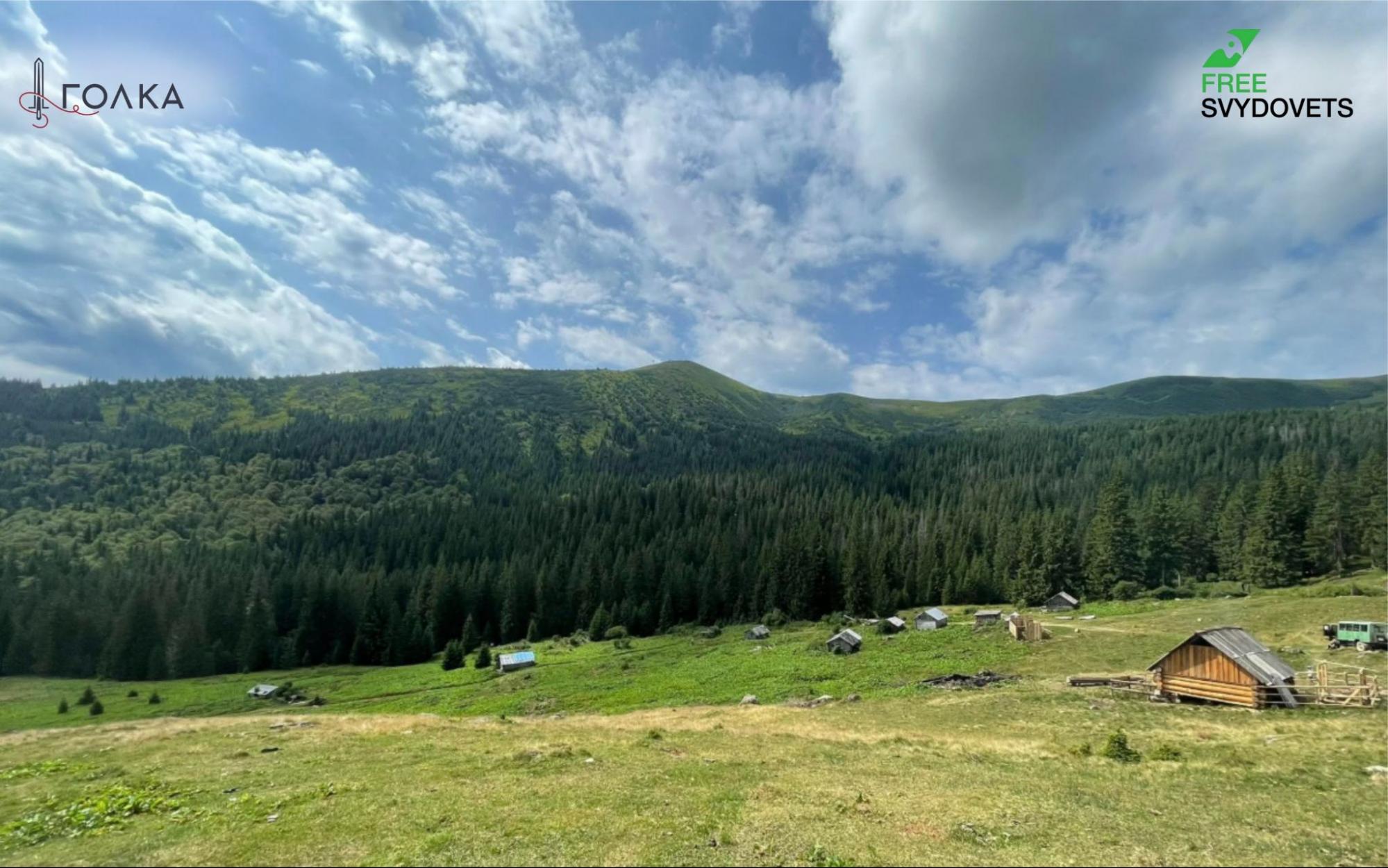
Krachuneska Meadow, where after the snow melts, Hutsuls bring their livestock to graze and make vurd (Carpathian cheese)
The distribution of land on the Krachuneska Meadow involves the former head of the Rakhiv District State Administration during Yanukovych’s presidency, Dmytro Andriuk, as reported by local media. Over ten years ago, at a village meeting in Chorna Tysa, he publicly promised to return the land to the community, but this never happened. Under such circumstances, it falls to the prosecutor’s office to defend the interests of the state, though law enforcement work is complicated.
In April, the so-called “Ihor Mazepa Law” (Draft 12089) came into force. It stipulates that land distributed during Yanukovych’s time or earlier cannot be reclaimed by either the state or the community. Because the law legalizes land stolen from the state, it has already been criticized by the European Parliament, and the Supreme Court has prepared a referral to the Constitutional Court.
The public initiative “Holka” investigated ways to protect the meadow from further development.

Polonyna Krachuneska is located in the Rakhiv district of the Zakarpattia region. To get there, it’s enough to simply descend from Drahobrat, which has been famous for its ski slopes for over half a century.
Mountain tourism is currently being developed here, including by families who have run this business for generations. Locals complain that the appearance of a “monster resort” nearby would deprive them of income and destroy the polonyna, where they graze their livestock.
Although fewer animals are kept in the mountains now, this polonyna still has a truly large pasture. The Hutsuls who spend the summer here with their livestock explain that this is because there is always water and the polonyna stays green even when other areas suffer from drought.
Shepherd Vasyl grazes his livestock on the polonyna and explains how his grandfather used to make “vurda” cheese here:
“Here’s the fire. Since spring, it doesn’t go out. And it keeps burning until the last animal leaves. That’s the tradition. The milk is poured into this barrel and strained through gauze and pine needles. And here is the ‘klyak’ – powder from the stomach of a young calf. It’s mixed with boiled water, added to the milk, and left to ferment. And this here is called ‘zbetela’ – it’s the Hutsul ‘mixer.’ Then you beat it all together. The milk settles at the bottom, leaving whey on top. You scoop it by hand and shape it inside the budz. The remaining whey is placed on the fire and boiled – that’s how vurda is made. Then people come and take their shares.”
Vurda is a traditional cheese made from whey in Hutsul regions, including Zakarpattia, sometimes with fresh sheep or cow milk added. Budz is fresh rennet cheese from sheep, cow, or goat milk, or dried homemade cheese. Budz and brynza are essentially the same product at different stages of its preparation.
Vasyl says that this cheese cannot be found in cafes or restaurants. Locals take it for winter supplies, or tourists visiting the polonyna buy it. Locals can order 20–25 kilograms at a time, storing it in the freezer to have enough for winter meals. One of the favorite dishes here is dumplings with vurda.
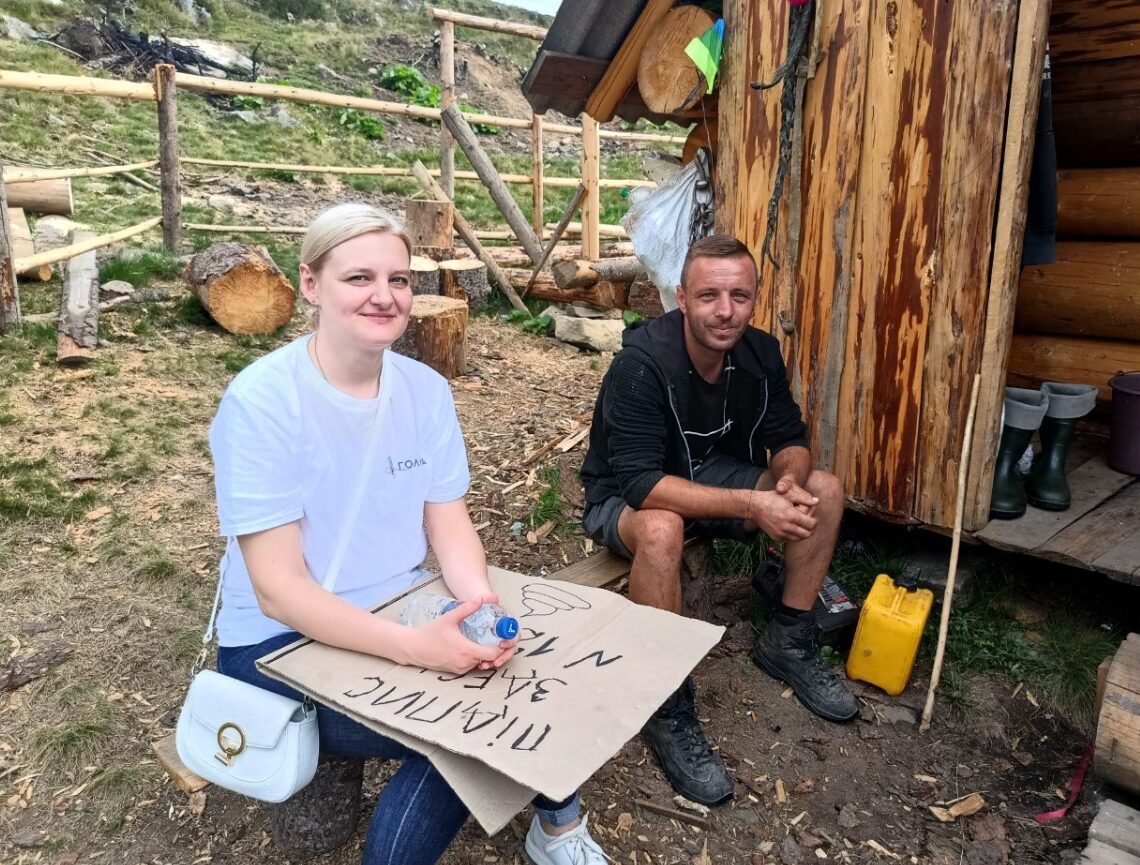
Visitors who came to Polonyna Krachuneska to get vurda cheese
The owners who received plots here are not currently managing the polonyna and are not disturbing the Hutsuls, but this could change at any moment, because on the cadastral map it has long been private property.
The polonyna was transferred into private hands more than ten years ago. This happened in 2012 based on an order from the then head of the Rakhiv District State Administration, Dmytro Andriuk (who represented the Party of Regions). The issue was that these lands were located outside the boundaries of settlements. Andriuk, together with the then head of the village Chorna Tysa, Ivan Pavliuchko, and the director of the Yasynia State Forestry Enterprise, Vasyl Telychuk, ensured that the land for haymaking was allocated to relatives of officials and their close associates. The total area of the plots is 20 hectares.
The circumstances of this case have been under investigation by law enforcement in a criminal proceeding since 2019. One of the land plots has already been resold, and there was an attempt to sell another. The value of one of the plots at the time of sale was $90,000, but the listing was removed after public disclosure.
In the summer of 2020, all eleven plots were seized with a ban on alienation or any disposition. However, last year the Uzhhorod City and District Court of Zakarpattia region lifted the seizure on one of the plots.
Several years ago, on the plot valued at $90,000, specialists from the “Ukrainian Environmental Protection Group” discovered illegal logging of century-old spruces. The perpetrators are still being sought.
Andriy Tupikov, an expert from the “Ukrainian Environmental Protection Group,” notes that such logging may be deliberately carried out by those planning to develop the polonyna:

Despite the October 2024 ruling of the Supreme Court, which was supposed to halt construction on the mountain ridge, a resort is still planned near the village of Chorna Tysa. This is confirmed by the development of a detailed plan.
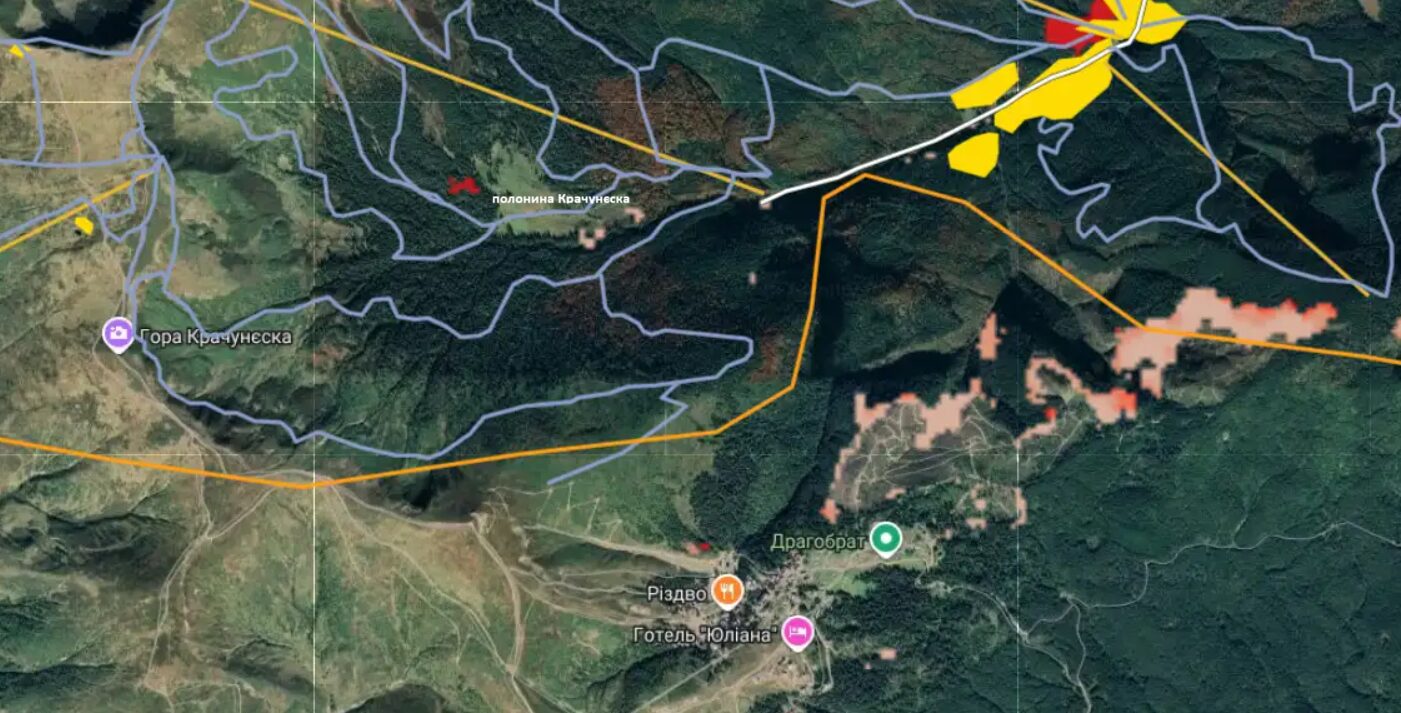
Polonyna Krachuneska. Infrastructure of the “monster resort” according to the detailed plans: white – roads, yellow – lifts, blue – ski slopes, red – site of illegal logging detected in 2022.
The head of the Zakarpattia Regional Prosecutor’s Office, Myroslav Patskan, notes that the prosecutor’s office has already responded to what is happening with Polonyna Krachuneska:

Biologist and environmentalist Iryna Shpakovska notes that the Polonyna Krachunyeska area has streams that feed the Chorna Tysa River:
“There are watercourses here, and the landscape includes alpine and subalpine meadows, high-mountain and old-growth forests, primeval and quasi-primeval forests. It is very important to maintain this balance on a self-sufficient level, and the establishment of protected natural areas could significantly improve the condition of these ecosystems and minimize the risks that already exist. That is why this territory is also included in the petition submitted to the Ministry of Environmental Protection for the creation of the ‘Free Svydovets’ nature reserve.”
A member of the “Free Svydovets” movement, the Frenchman Orest Des Sol, has been farming in the Carpathians for the past 20 years. He married a Ukrainian and runs his own farm here. He is one of the activists responsible for keeping Svydovets undeveloped and invites representatives of European embassies and international delegations to the Carpathians:
“Krachunyeska is a beautiful and unique polonyna, and photos and videos cannot fully convey its beauty. Svydovets as a whole should become a nature reserve, and this idea is supported by the ‘Free Svydovets’ community. You can see that for more than a century, people from the villages in the valley have been grazing their cows and sheep and running traditional farms. In these wooden huts, people live throughout the summer and make cheese – this is their livelihood. The polonyna should remain community-owned. There is a lot of water here, and many herbs and flowers grow around. Building a resort would disrupt the water balance, and the entire community would face water problems. Unfortunately, the current ‘Igor Mazepa Law’ complicates the work of the prosecutor’s office and the return of plots that were stolen over 10 years ago.”
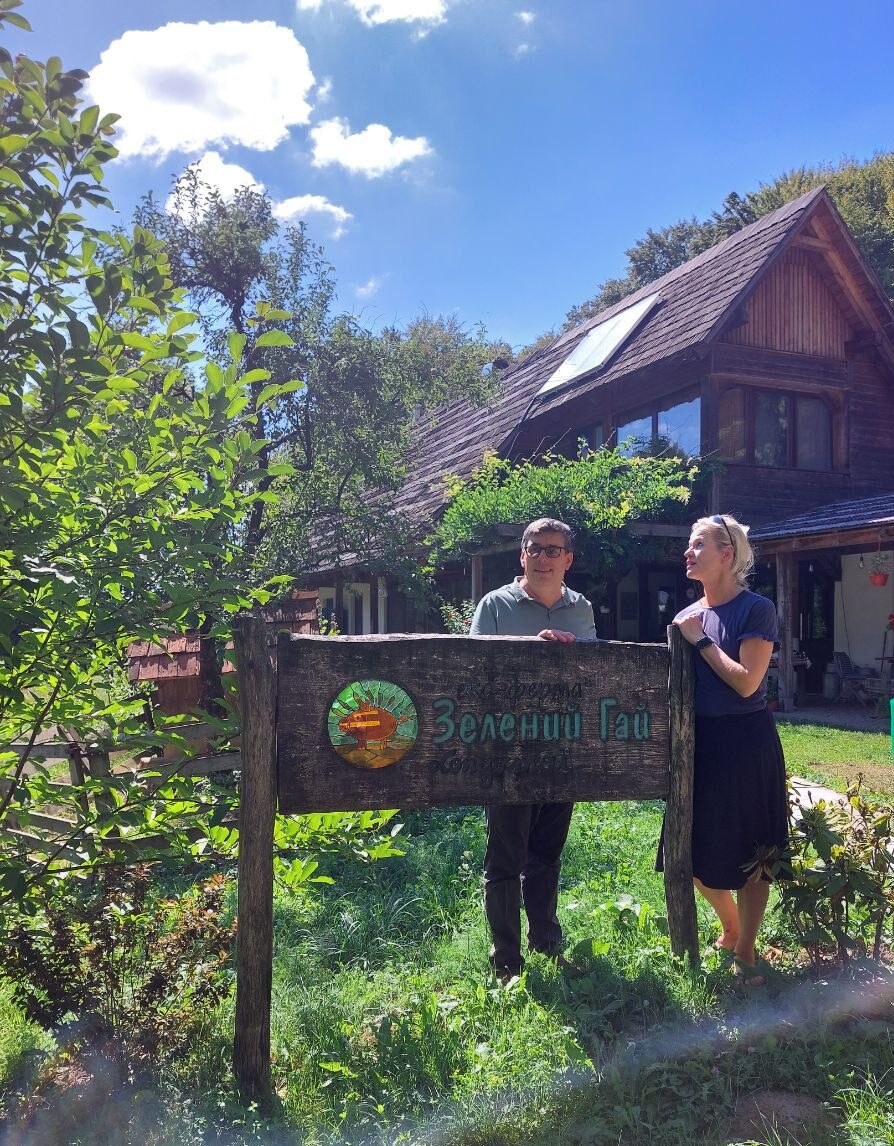
The Frenchman Del Sol at his farm “Zelenyi Hai” in the Carpathians

In October of last year, the Supreme Court protected Svydovets with its ruling, which could not go unnoticed by Kolomoisky’s team. In the same month, the Verkhovna Rada registered the “Ihor Mazepa Law” (Law “On the Bona Fide Acquirer” 4292-IX). It provides for the “resetting” of claims against participants in land schemes who acquired forests and riverbanks as private property over 10 years ago.
If 10 years have not yet passed, the community or the state must deposit the market (!) value of the land with the court. That is, if 10 years had not yet elapsed since the land distribution on Polonyna Krachuneska, the local budget would have had to deposit $90,000 per plot to the village council if it won the lawsuit – the landowner would have taken the budget funds.
Andriy Delyatynchuk, head of the Yasinia community, explains why a resort is necessary for the local authorities here:

Of course, if the local authorities support the construction of the “monster resort,” the budget funds may never be deposited with the court. In that case, the work of the prosecutor’s office is blocked.
The first victim of the Mazepa Law was Kyiv’s Protasiv Yar, defended by the late Roman Ratushnyi. The court refused to consider the prosecutor’s claim until the budget funds were deposited.
It is important to understand that before the legislative initiative was registered, there was an active media campaign involving businessman Ihor Mazepa, who was detained by the SBI over suspicions of land schemes. Several Telegram channels and media outlets portrayed Mazepa as an “honest businessman” opposing “bad law enforcement.” Hence, the idea emerged that claims against the business should be “reset.” Yet, less than six months after the law’s adoption, the European Parliament saw this reset as a legalization of stolen property, because communities and the state would no longer be able to reclaim their assets. In other words, the law is not aimed at protecting honest businesspeople.
The key author of the “Ihor Mazepa Law” is MP Ihor Fris, elected by residents of Ivano-Frankivsk. The politician is part of the “Kolomoisky Group” in the Verkhovna Rada. For Fris’s family, developing green zones is a family business—Bihus.info produced a dedicated report on this. The politician’s daughter is a co-founder of a company that was previously allocated over 10 hectares of forest.
The sanctioned company linked to oligarch Ihor Kolomoisky, “Scorzonera LLC,” in which he is listed as the ultimate beneficiary along with his business partner Hennadiy Boholiubov and through Derling LLC (according to the YouControl analytics system), became interested in Svydovets exactly ten years ago. Therefore, the initiative of a Kolomoisky group deputy, Ihor Fris, to “reset” claims for land schemes from a decade ago is unsurprising.
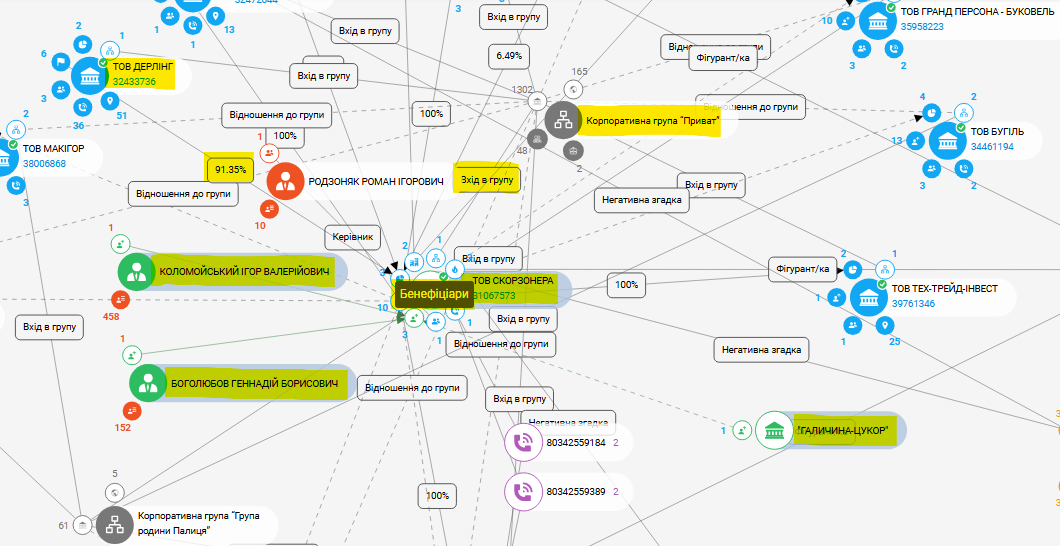
The connection scheme of Scorzonera LLC with Ihor Kolomoisky according to YouControl data
Derling LLC owns a 91.35% stake in Scorzonera LLC. The remaining 6.49% and 2.16% are held by Makevs and Halychyna-Cukor, respectively. The liquidated Makevs LLC was linked by the media to the MP and another business partner of Kolomoisky, Ihor Palytsia, while Halychyna-Cukor belongs to the family of the current deputy of the Ivano-Frankivsk Regional Council from the “For the Future” party, Oleksandr Shevchenko. The now-familiar ex-Regionals member Andriuk is currently a deputy of the Yasynia settlement council from Palytsia’s political force.
The idea of building a “monster resort” was supported by the Zakarpattia Regional State Administration as well as the Rakhiv and Tiachiv District State Administrations, which acted as clients for the detailed plans of the resort.
On 1,400 hectares, they plan to fit 230 km of ski slopes, 90 km of roads, 60 hotels, 390 cottages, 120 restaurants, and 33 lifts. The resort was designed to accommodate 22,000 tourists and 5,000 service personnel simultaneously. The projected total water intake was to be 160,000 cubic meters. For all this, it would also be necessary to remove 800 hectares of high-mountain forest from the state forest fund and cut it down, even though it currently has especially important protective, water-regulating, and anti-erosion functions.
Oleh Lystopad, an ecologist and expert of the ANTs Network for the Protection of National Interests, notes that the roads currently being built for the installation of wind turbines in the Carpathians could be used for constructing the already planned resorts, including in Svydovets:

Currently, the parliament has managed to block changes to the law that would have allowed the construction of wind turbines without an environmental impact assessment. However, those pushing the changes fell short by just one vote, so it’s quite likely they will try again. The "Ihor Mazepa Law" should be repealed immediately. The risks highlighted by both environmentalists and our European partners pose a threat not only to the environment but also to Ukraine’s European integration course.
Exclusively for “Glavcom“