
There is no public discussion of headmen candidates. What is wrong with this?

During martial law, the parliament restricted the rights of citizens, and they would not be able to participate in the discussion of headmen candidates. From now on, the headmen will be appointed by local councils. On July 17, the Verkhovna Rada passed the relevant law and submitted it to the president for signature (No. 9518).
This excited the public, because it is impossible to hold elections during the war, and citizens would like to have an impact at least on the appointment of village elders. Moreover, until recently, there were both heads and councils. The situation changed in 2020 after the consolidation of communities.
On the other hand, headmen or ‘starostas’ are supposed to be the ones who provide administrative services and may eventually even play the role of a “justice of the peace” in minor disputes. However only 5% of headmen currently provide such services, so the legislator could consider this and introduce a longer transition period for the paradigm shift.
 ‘Starostas’ represent the interests of the villagers, communicate between the authorities and the village community, intensify this dialogue and facilitate community involvement in decision-making, solve community problems, and organize events in the village.
Usually, those who live in densely populated districts become deputies of local councils, because small villages that are part of large community associations cannot physically cast as many votes for their candidate. Because of this, villagers feel underrepresented in the council, and so for them, the opportunity to influence the choice of ‘starosta’ now is an opportunity to have their representative.
At first glance, the adoption of the law narrowed the procedures of direct democracy. Even though the requirements of the Law “On the Legal Regime of Martial Law” restrict the holding of mass events, the legislator could have taken a more flexible approach to such a sensitive issue as public discussion of starosta candidates. Such discussions could be banned only on the territory bordering the combat zone. That is, where events such as general meetings cannot be held for security reasons.
Kateryna Ivanchenko, head of the Center for Innovations Development, in a commentary to the Holka civic initiative, emphasizes that the rights of citizens are already significantly restricted during the war. She notes that this decision is being justified by the fact that there are problems with citizen engagement in the frontline areas:

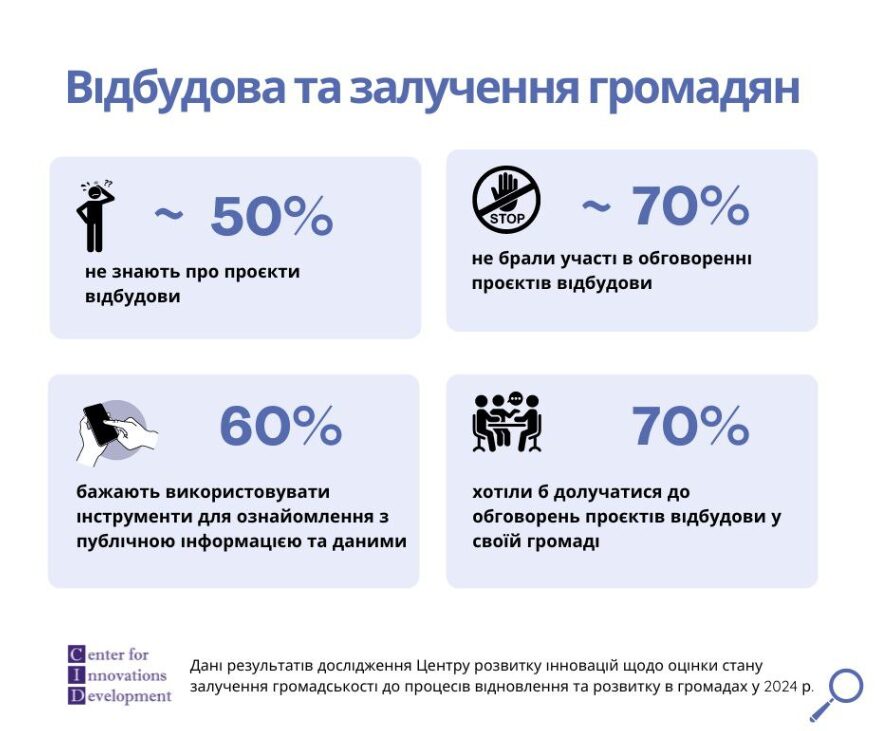
This limitation of direct democracy has revealed both the problem of tools for engaging citizens in public administration in general and the status of the starostas themselves.
According to the new law, the official website of the council must contain information on the time and place of the meeting on the approval of the starostas. This information must be provided no later than two days before the day of the meeting. This is the only thing that the state guarantees to citizens in terms of participation in the election of starostas.
Council regulations should provide for a procedure by which the citizens present can express their opinion, including on the election of starostas. Therefore, the participation of concerned citizens in the process of approving starostas should be ensured at least in this way. However, it should be noted that not all councils inform citizens about the time and place of meetings, and those who preside do not always follow the rules and give the word.
The new law, which is awaiting the president’s signature, also stipulates that the procedure for public discussions of starosta candidates should be approved by the council in the future. Such a procedure should become part of each community’s charter.
However, it should be understood that public hearings held on the ground should not be held “for the sake of appearances.” There are numerous cases when representatives of the developer, state employees, and the ‘titushky’ appeared at the hearings under the guise of the public. The classic example here is the “public” hearing in Irpin to approve the city’s master plan. The documents were prepared so poorly that as a result of such “hearings”, the “port of Ochakiv” and even the coastal strip along the Black Sea appeared in the master plan of Irpin.
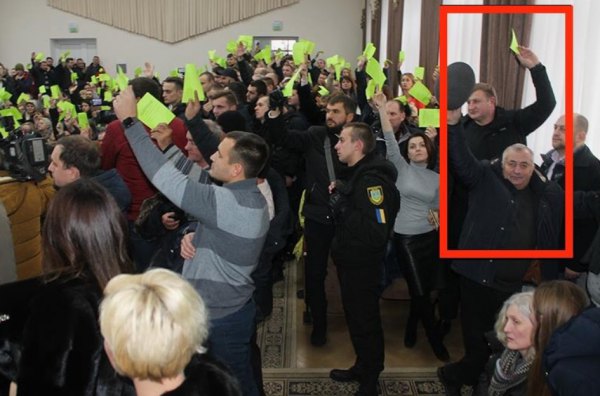
“Public” hearings on the Irpin city master plan in 2018, which were attended by residents of other communities and state employees
The general meeting, which was supposed to be the main form of discussion of the starosta’s candidacy, showed low participation of villagers. But here we should note that the development of direct democracy tends to encourage primarily active citizens, who, although few, have a rare potential for active participation in public life. That is, there should be quality versus quantity.
 MPs amended the law to strengthen the role of the council in approving starostas. The mayor has the first right to propose starosta candidates for consideration by the council, and he has two attempts. If the majority of the deputies do not support them, the initiative passes to the deputy corps. If even after such a proposal the council does not get enough votes for the starosta candidate, the mayor gets the right to appoint the starosta themselves.
Thus, the status of starosta is slowly evolving from a political figure (as it was considered when this institution was introduced) to an actual representative of the executive body (whose formation is influenced by the mayor) in the territory of the starosta district.
Mayors, of course, emphasize that the starosta position should not be political and would like to have a direct influence on such appointments.

The proposal to elect the starosta in direct elections is broken down by the issue of creating a parallel institution of representative power to the council but without clear powers.
If the starosta represents the executive body of the council, then in this case, given the principle of a clear separation of the representative and executive branches of government in the community, they should not be approved by the council at all. After all, its functionality does not involve making discretionary, i.e. political decisions. Moreover, the new authority to track the presence of persons liable for military service, which appeared in connection with the streamlining of military registration, cements his status as a local government employee who actually represents not only the executive body of local self-government but also the state.


Tomasz Lewandowski, who works as the Director of Marketing and Corporate Communications at a medical center and has been a soltis of Sulkowice (Hynów Commune, Poland) for 10 years, notes in his commentary to the Holka civil initiative that the transfer of authority to elect starostas to local governments may lead to a change in the perception of the starosta function:

 Today, the starosta is more of a feedback system, a kind of “mayor’s eyes” without direct authority. However, in the future, they may be granted the authority to collect real estate and land taxes, as is done in Poland by the soltis, who are essentially the same starosta. After all, there has long been a question of transferring the administration of local taxes and fees to local governments.
There have also been proposals to grant starostas the status of magistrates, who should resolve domestic disputes, thereby relieving the judicial system. The first bell has already rung – cases of theft of items worth less than UAH 3 thousand have been decriminalized. That is, there will be no jail time for this, but such thefts remain an antisocial phenomenon. And it is the starosta who would have to settle these issues in addition to the difficult mission of reconciling neighbors and quelling marital quarrels. Thus, the position of starosta increasingly requires specific knowledge and skills necessary for public service.
Pavlo Ostapenko, an expert on territorial development and local self-government, notes that starostas have been able to provide administrative services for three years, provided that there is a corresponding decision of the council:

The role of starostas in ensuring citizens’ access to public authorities as intermediaries and communicators will increase. The law passed by the parliament lowered the minimum number of people to form a starosta district to 200 citizens. This raises the question: what about direct democracy in the approval of starosta candidates? A starosta should be “one of the people” for rural residents. Whereas the legal requirement for public discussion during his appointment has been canceled, the need for consultations with the population for community leadership will always remain. The legislator proposed that the form of these consultations be determined by the local council.
At first glance, the issue of the status and role of starostas in the local self-government system seems not to be the most important in the kaleidoscope of urgent and complex current tasks, multiplied by the war. However, it confirms the thesis that the organization of public power is a rather complex task that does not entail simple solutions. Only the authoritarian way of governance looks simple, but it is ultimately ineffective. This has been proven by history, in particular since Ukraine became independent.
It is worth reminding that today almost every fifth community is left without a community-elected head. It is worth mentioning that the Holka civic initiative has investigated how to solve the problems that exist between the representative and executive branches of government at the local level.
Specially for “Dzerkalo Tyzhnia”