
Raking the Same Ground and the Constitution on Pause: What Awaits Us with the Government Change?

It is already known that three ministries may be merged into one Ministry of Resources, which will include the Ministry of Agrarian Policy, the Ministry of Environment, and the Ministry of Economy.
This is one of the worst decisions and a sign that during reconstruction, the protection of green zones will be seriously threatened. And the fact that a few months ago the president signed the “Ihor Mazepa law,” which nullified claims against owners of stolen property, gives us an understanding that the threat is scaling up (this concerns draft law 12089). Zelensky signed the law despite citizens gathering 25,000 signatures on a petition demanding a veto. Several ministries also demanded a veto, including the Ministry of Environment, but these demands were neutralized.
Now imagine that a law with serious risks has passed through parliament. There will no longer be a separate Ministry of Environment institution to provide veto recommendations. The voice of ecologists will be drowned out by the agricultural sector. They need to exploit the land and sow it. And the economy will say: “We need investments.” Merging three such ministries into one is like deliberately letting a fox into a henhouse and expecting to collect eggs there.
Besides the ecological threat, there is another danger — purely from a management perspective. As soon as Zelensky gained a parliamentary majority in 2019, the Ministry of Culture was decided to be merged with the Ministry of Youth and Sports. It took about six months to create the new merged ministry, and it cost enormous effort because this involved staffing and property issues. And what was decided after six months? To split it back into two ministries. Is this back-and-forth movement effective? No. That is why the then Minister of Culture cited the new division of his ministry into two as one of the reasons for his resignation.
Since then, the Ministry of Culture has been in disarray. First, the controversial Oleksandr Tkachenko was appointed minister, who came up with replacing the trident gesture with one carrying a sexual connotation, and later we heard: “Sorry, we messed up.”
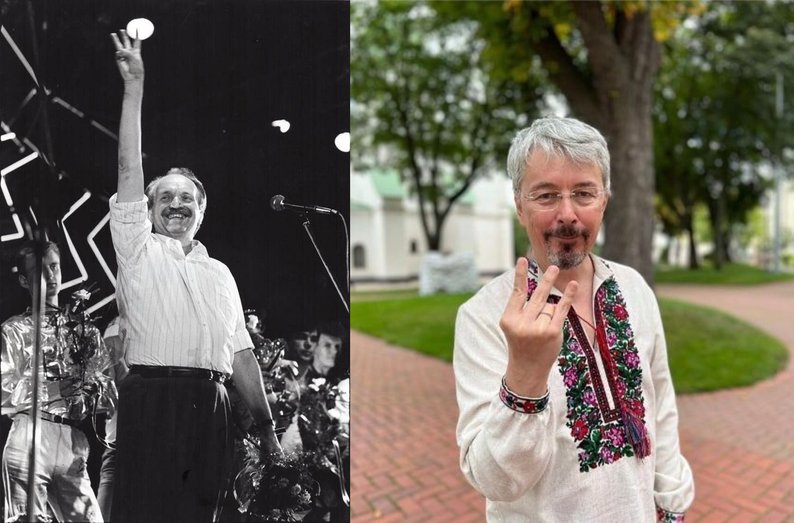
Vyacheslav Chornovil shows the trident, and former Minister of Culture Oleksandr Tkachenko, who decided to change the gesture symbolizing the trident
After that, Rostyslav Karandeyev acted as minister for a long time, and the country lived not just without a minister but, in the context of heritage preservation, the rules reverted to those from Yanukovych’s time. Everyone hoped the situation would change with Mykola Tochytskyi, but it didn’t. He is now likely to be sent somewhere as an ambassador.
Who will lead the Ministry of Culture now is unknown. And during the war, one must look at the state’s strategy, where preserving our identity should play a key role, especially since many Ukrainians were forced to leave the country.
If the enemy tries to destroy our identity, erasing from the face of the earth in Lviv the Shukhevych Museum, we have developers destroying not only green zones but also cultural and archaeological heritage — Pyrohiv, the Kytaiv tract, the Museum of Outstanding Figures of Ukrainian Culture.
There is also an issue with the Ministry of National Unity. It was created based on the Ministry of Reintegration, and questions arose — who will deal with IDPs when the Ministry of National Unity focuses only on Ukrainians abroad? Now the ministry is reportedly going to be liquidated: Minister Chernyshov is under suspicion but continues confidently to write about achievements. One of the latest achievements he promotes is the government’s support of the Ministry of National Unity’s resolution on developing the Unity Hub network for Ukrainians abroad. What will happen to all this now? And what to do with the trust of Ukrainians abroad, who after years of state neglect positively perceived the creation of this ministry?
Moreover, society raises questions about whether the Ministry of Veterans should be merged with the Ministry of Social Policy. Here is what Lyudmyla Darahan, former State Secretary of the Ministry of Defense, wrote about it:

So this merging-splitting is a case of #AlreadyDoneThat.
The government could become a coalition during wartime, including experts. Instead, we see the deck shuffled and society presented with this as change. Without the possibility of elections during war, the government is a variable that can bring renewal to the political system and launch policy development.
Editor of the Internal Politics Department, Inna Vedernikova, wrote in 2023 about what and why needed to be done in the government:

But this can only happen when there is care for preserving not only statehood but also democracy. And if the president confidently talks about changing the prime minister, forgetting that according to the Constitution, decisions are made by parliament, it multiplies the above-mentioned threats.
The situation when the Constitution and democracy are put on pause is very harmful in peacetime. And during war, such actions can be more than destructive.
Specially for “Ukrainska Pravda”