
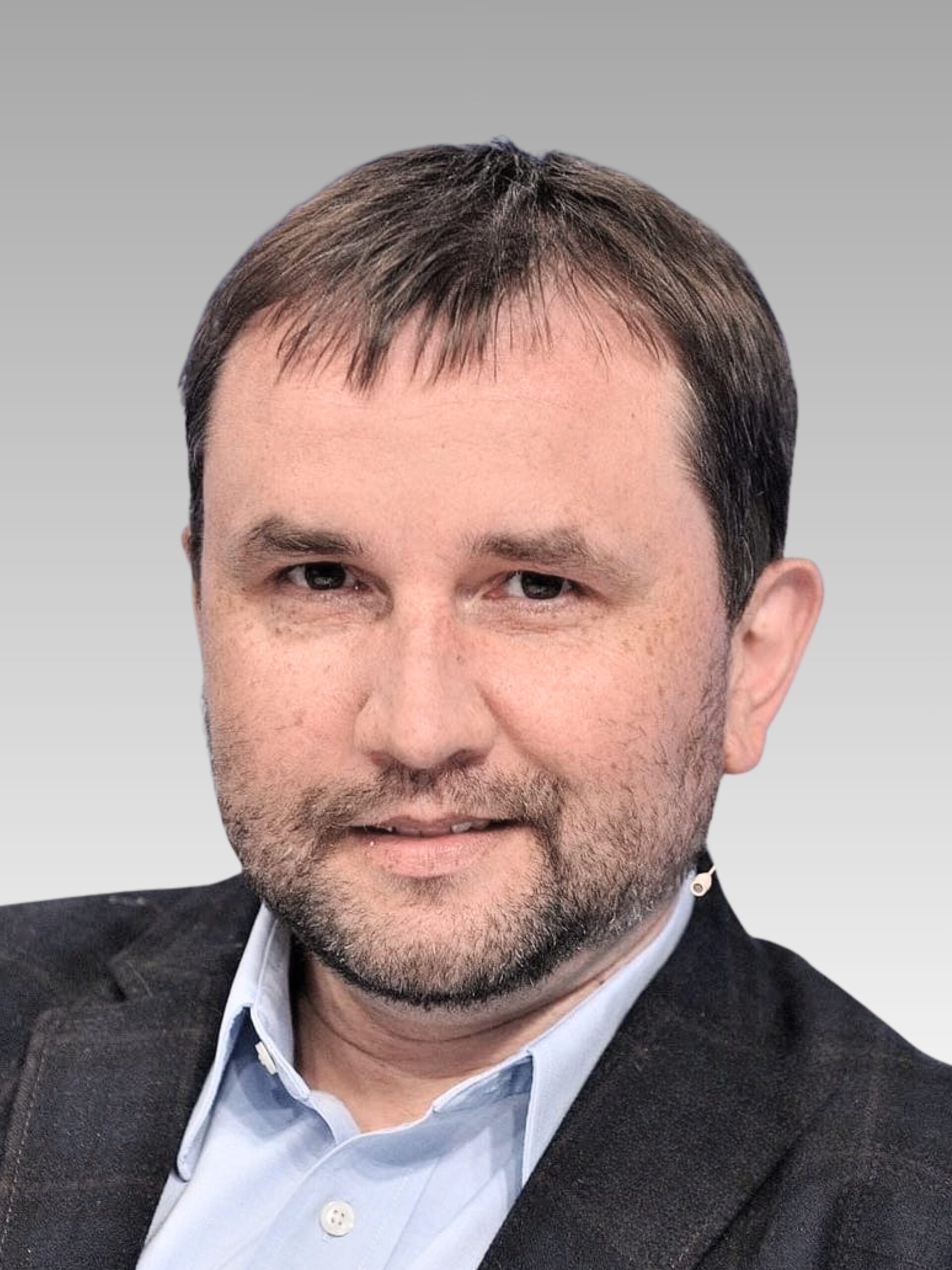
Volodymyr Viatrovych
Фракція політичної партії "Європейська солідарність"
Region
None


Green: voted for beneficial and against harmful bills, red: voted against beneficial and for harmful bills. Yellow: abstained. Dark grey: present but did not vote, or absent.
Green: voted for beneficial and against harmful bills, red: voted against beneficial and for harmful bills. Yellow: abstained. Dark grey: present but did not vote, or absent.
Biography
Volodymyr Viatrovych initially ran for the 9th convocation of the Verkhovna Rada for the “European Solidarity” party (No. 25 on the list), but did not secure a seat at the time. He received his representative mandate after Iryna Lutsenko resigned and Nataliia Boiko declined the seat. He was elected as a member of the Verkhovna Rada Committee on Humanitarian and Information Policy.
He was actively involved in the Revolution of Dignity. He served as the head of the Ukrainian Institute of National Memory. After Volodymyr Zelenskyy won the presidential election, it was pro-Russian politician Maksym Buzhanskyi who announced that Viatrovych was being dismissed from his post. In that role, Viatrovych worked to rid the country of totalitarian symbols through decommunisation, opening KGB archives, recognising members of the OUN-UPA as fighters for independence, and popularising Ukrainian history, given his background as a historian. The politician is on Russia’s sanctions list.
Viatrovych is a publicist who lectures on topics including the Polish-Ukrainian conflict. Reports once appeared in Polish media regarding a travel ban on Viatrovych entering Poland, but this information was never officially confirmed. The MP viewed the spread of such information as political pressure. At the time, Polish diplomats claimed it was unacceptable that the dialogue with Warsaw had been entrusted to an “irresponsible person with obsessive anti-Polish ideas.” The historian emphasised that “Poles were killed and Poles killed, Ukrainians were killed and Ukrainians killed.” Later, the MP explained why the Polish government should maintain focus on this conflict even in the midst of a full-scale war, citing upcoming presidential elections.
He submitted a formal statement to the Security Service of Ukraine (SBU) regarding possible high treason by Andriy Yermak in the context of potential direct negotiations with the occupied territories (ORDLO).
Timeline of Key Events
2025
Abstained from voting on the project concerning a special procedure for the compulsory alienation of land in the Uzhhorod district of the Zakarpattia region (#9549). The initiative contained a number of scandalous provisions creating risks for both deforestation and the development of a corrupt scheme to purchase real estate using budget funds at prices 3–3.6 times higher than market value. These provisions violated several constitutional articles, leading the President to veto the bill. Despite this, MPs ignored most of the objections during the revision. Among other things, during the revision for the second reading, provisions were added to the law that would legalise, until the beginning of 2028, a corrupt scheme by local government bodies to develop detailed plans in violation of the provisions of settlements’ master plans.
Abstained from voting on the so-called “Ihor Mazepa Law” (Draft 12089). This legislative initiative essentially reflected the demands of unscrupulous businesses. The law provides for the “resetting” of claims regarding illegally acquired forests and coastal lands if ten years have passed since they entered private ownership. This means that all such land grabs that occurred over the last decade could be legalised. If the 10-year period has not yet passed, then before filing a lawsuit to save the property, the state or local budget would be required to deposit the value of the property in question into a court account. Despite a petition demanding a veto gathering over 25,000 signatures, President Volodymyr Zelenskyy signed the document. The first victim of the “Ihor Mazepa Law” was the case concerning Protasiv Yar, which was defended by the late scout and Kyiv resident Roman Ratushnyi.
Abstained from voting on the controversial bill submitted by Speaker Ruslan Stefanchuk, which abolished the Commercial Code of Ukraine (#6013). While the initiators declared an expansion of economic freedoms, the law canceled fundamental norms of state-business interaction and governance in state and municipal economic sectors. A number of NGOs emphasised that the law posed risks to national security and could lead to a large-scale redistribution of the country’s assets, given that the Verkhovna Rada had not approved a list of property exempt from privatisation.
2024
Voted against bill #10242 on pressure on journalists and their sources. This bill created serious risks for freedom of speech, the work of journalists, and the protection of sources and whistleblowers. Under the guise of combating “data abuse,” it proposed amendments to the Criminal Code that would increase penalties for disclosing information from state registers during martial law—up to 8 years in prison, with no exceptions for journalists or anti-corruption whistleblowers.
Voted for bill #8371, which provided for the prohibition in Ukraine of religious organisations whose governing centre is located in a state carrying out armed aggression against Ukraine. He actively advocated for this issue.
2023
Abstained from voting on the project #7457 “On the Legalisation of Medical Cannabis,” which allowed the production of medical cannabis in Ukraine for the rehabilitation of wounded military personnel, including for the treatment of PTSD. The adoption of the law was advocated by the “Patients of Ukraine” organisation.
Voted for bill #9296-d on strengthening financial monitoring of Politically Exposed Persons (PEPs). The key change introduced by the bill was the introduction of a lifelong PEP status for top officials, replacing the current three-year limit after leaving office. Additionally, the document strengthened the liability of primary financial monitoring entities (notably banks) for unjustified refusals to provide financial services.
2022
Supported law #2693-d “On Media,” which provided for the relaxation of restrictions on Russian content and performers, and the regulation of online media, bloggers, and various web platforms. The document also expanded the powers of the regulator—the National Council of Television and Radio Broadcasting. Adoption of this law was one of the conditions for starting negotiations on Ukraine’s accession to the EU. At the same time, journalistic, media, and civic organisations, media outlets, and social media users appealed to the authorities regarding this bill, stating that the law violated the right to freedom of expression guaranteed by the Constitution of Ukraine and the Convention for the Protection of Human Rights and Fundamental Freedoms.
Voted against the urban planning “reform” (#5655), authored by the head of the “Servant of the People” party, Olena Shuliak. The civic sector and media criticised this legislative initiative, and Chatham House (Britain) noted that with such rules of the game, there is every chance for the emergence of construction cartels. The European Parliament warned President Zelenskyy against signing the law, and the European Commission also provided critical comments.
2020
Ran for the Ivano-Frankivsk Regional Council for the “European Solidarity” party and, despite winning as the first person on the list, declined the mandate to remain in the Verkhovna Rada. This is a standard political technology where MPs are placed at the head of lists in local elections to gain more support.
Voted against resolution #4104, by which parliament approved its representatives to the competition commission for selecting the leadership of the Specialised Anti-Corruption Prosecutor’s Office. The composition of this commission drew large-scale criticism from civil society, EU delegations, and G7 countries, as it included individuals whose independence and integrity were in doubt.
Following a complaint by Viatrovych, the Security Service of Ukraine opened a criminal case regarding possible high treason by representatives of the Ukrainian delegation in the Minsk negotiations—Head of the Office of the President Andriy Yermak and the second President, Leonid Kuchma.
The State Bureau of Investigation summoned the MP for questioning as a witness following a statement by “Servant of the People” MP Maksym Buzhanskyi regarding a 2018 forum dedicated to the 85th anniversary of the Holodomor. Buzhanskyi accused Viatrovych of embezzling 500,000 UAH for the event. Viatrovych himself called the accusations “revenge by the empire.”
2019
Ran for the 9th convocation of the Verkhovna Rada for “European Solidarity” (No. 25 on the list), but was not elected. Due to the change in government, Viatrovych was dismissed from his post as head of the Ukrainian Institute of National Memory. Before Zelenskyy’s trip to Poland, he managed to prepare information on Ukrainian-Polish relations.
Later became an MP after Iryna Lutsenko resigned and Nataliia Boiko declined the seat. He was elected as a member of the Verkhovna Rada Committee on Humanitarian and Information Policy.
In an interview with Bihus.Info, he stated that “Volodymyr Zelenskyy is definitely a ‘Maloros’ [Little Russian] as an actor and cultural figure. Signs of this are already present in his politics.” According to the politician, signs of Zelenskyy’s “Maloros-ness” were manifested in the fact that there were no official events at Babi Yar, and he was not present at such events as President.
Viatrovych announced his joining of Petro Poroshenko’s election team. Subsequently, the Cabinet of Ministers dismissed Viatrovych from the post of head of the Ukrainian Institute of National Memory.
Russia opened a criminal case against the Ukrainian politician “for the rehabilitation of Nazism.”
2018
Russian authorities included Viatrovych in their sanctions list.
2017
Information appeared in Polish media that Viatrovych had been banned from entering Poland, but this information was not officially confirmed. The Ukrainian politician noted that the mere spread of such information constituted political pressure.
2014
Appointed head of the Ukrainian Institute of National Memory.
2008
Served as an advisor on research for the head of the Security Service of Ukraine. From this year until 2010, he was the director of the Branch State Archive of the SBU. Until 2014, he was the head of the Academic Council of the Centre for Liberation Movement Research.
2002-2008
Founded and headed the Centre for Liberation Movement Research in Lviv, worked as a research fellow at the I. Krypiakevych Institute of Ukrainian Studies of the National Academy of Sciences of Ukraine, taught at the Ukrainian Catholic University, and was a representative of the Ukrainian Institute of National Memory in the Lviv region; in 2008, he headed its archive department.
If, in your opinion, this profile contains inaccurate information, please contact us in writing at ngo.holka@gmail.com. The team of the Holka civic initiative will review your submission and provide a response.
Voting record
For
- On the Judiciary and the Status of Judges (3711-д)
- The Emerald Network (4461)
- Restoration of Financial Reporting for Political Parties (Amendment No. 93) (5253-1)
- Denunciation of Certain Agreements under CIS Treaties (0101)
- Ban on Pro-Russian Political Parties (7172-1)
- Ratification of the Istanbul Convention (0157)
- Establishing May 8 as the Day of Remembrance and Victory over Nazism (9278)
- Restoration of Asset Declaration (9534)
Against
Abstained
- Fake Abolition of Parliamentary Immunity (2237)
- Criminalization of “Button-Press Voting” (2148)
- Reduction of Industrial Emissions (4167)
- Ensuring Constitutional Rights to Life, Health, and Environment (6004-д)
- Medical Cannabis (7457)
- Corruption Schemes Disguised as Investor-Friendly Changes (9627)
- Abolition of the Commercial Code (6013)
- Special Expropriation Powers in Zakarpattia (9549)
 Absent
- On the Deprivation of State Awards from Traitors (11410)
- Prevention and Control of Industrial Pollution (11355)
- Time Calculation in Ukraine (4101)
- Limiting the Recovery of Illegally Privatized Forests and Coastal Lands (12089)
- Restrictions on Public Disclosure of Lawyers’ Clients (12320)
- Undermining the Independence of NABU and SAPO (12414)
- Condemnation of Protests on Bankova Street (5295)
- Recognition of the Revolution of Dignity as a Key Moment of State-Building (2739)