
Why the law on eliminating the independence of anti-corruption bodies is just the tip of the iceberg?

Essentially, the signing of draft 12414, which eliminated the independence of the key anti‑corruption bodies – NABU and SAP – is the final step that was supposed to make the embezzlement of state and municipal property safe for insiders.
But in order to make theft easier, the system was prepared quite thoroughly.
What has happened over this year so far?
Firstly, a large‑scale redistribution of the country was legalized.
The year began with the destruction of the Commercial Code at the prompting of Speaker Ruslan Stefanchuk (Draft Bill 6013 became law). This happened even though the Verkhovna Rada failed to fulfill its constitutional duty and did not approve a list of assets that cannot be privatized. Such a list existed once, but “Motor‑Sich” was excluded from it. The consequences are felt nationwide, because aircraft engines ended up in the hands of the enemy, and now we are heroically prosecuting Bohuslayev.
What did parliament and the president not pay attention to?
A number of civic organizations emphasized that this law carries risks to national security and that its adoption would result in a large‑scale redistribution of the country, given that the Verkhovna Rada failed to approve a list of assets that are not subject to privatization. The following organizations opposed Draft 6013: “Holka”, “Ecology. Law. Human”, “Ukrainian Nature Conservation Group” and others, who asked Zelensky to veto the draft. The Association of Ukrainian Cities also opposed this law.
Secondly, the “Mazepa law” nullified claims against those who plundered during the Yanukovych era.
The legislative initiative by MP Ihor Fris (Servant of the People) envisages the “nullification” of claims against those who plundered forests and coastal zones, if ten years have passed since the plunder and the assets have entered private hands. If the ten-year term has not yet expired, then before filing a lawsuit to recover the property, one must deposit the value of the property in question from the state or local budget.
What did parliament and the president overlook?
Dozens of civic organizations signed an appeal to the president demanding a veto of the bill (Ukrainian Nature Conservation Group, Ecology – Law – Human, Ecosphere, ANTS, CHESNO movement, Price of the State, and others). A petition on the Presidential Office website demanding veto gathered over 25,000 votes in less than two weeks. But the president ignored this and signed the law. Protasiv Yar became the first victim in court.
Moreover, the Ministry of Environment, which had recommended that the president veto the bill, no longer exists. It was merged with the Ministry of Agro and the Ministry of Economy. That is, in the government that is supposed to protect our rights and freedoms, one of the safeguards was destroyed. Even if it was not heeded during the consideration of the “Mazepa law”, at least it existed and strengthened the position.
And now the same MP Ihor Fris, who promoted the Mazepa law, is pushing the next initiative – closing registers. That is, journalists and activists may realistically lose the ability to learn important information about illicit enrichment.
Thirdly, staffing policy and rhetoric of newly appointed officials.
The fact that after the competition we did not receive a head of the BEB was discussed far beyond Ukraine. Media editorial teams issued statements, and the civil sector also made their voices heard.
For the newly appointed prime minister, the issue of not appointing a BEB head was not problematic. What did Yuliia Svyrydenko focus on instead?
Essentially, she began with the theme: “Business gets everything, and everyone else can wait.” Consider her first post item: “Moratorium on inspections of business.” Let’s enforce a moratorium on firefighters putting out fires, or on teachers checking homework. If there are violations in the activity of business, they shouldn’t just be able to be inspected—they must be inspected. But this turns out to remove all limits on business. And the government, which no longer has the Ministry of Environment, is reinforcing this policy.
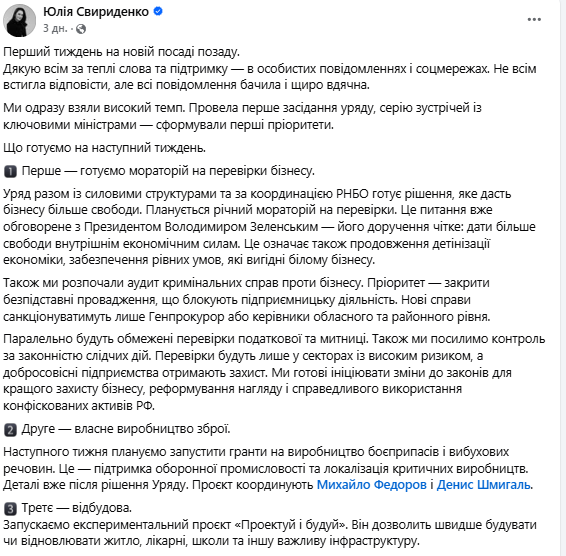
Screenshot from the post by Prime Minister Yuliia Svyrydenko
And the third point in her post is “reconstruction.” It is simply paradise to receive billions for reconstruction, have no inspections, and have legislative and executive frameworks that will work not for the people of Ukraine, but for one sector—business.
The newly appointed Prosecutor General Ruslan Kravchenko immediately stated that business-related cases are being closed by the thousands.
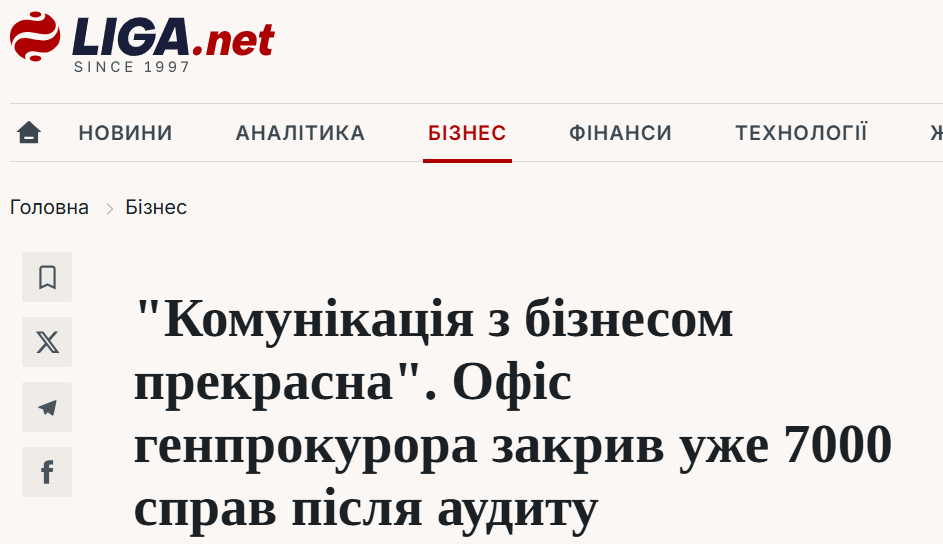
Screenshot from Liga.net article
Citizens who turn out in war for mass protests see in the destruction of the independence of anti‑corruption bodies just the tip of the iceberg.
But I would like the authorities to understand. Ukrainians now have many new competencies. And they extend far beyond the cardboard revolution. For example, with 3-D printers one can print everything necessary for drones.
There are those whose parents died on the front lines or in occupation. There are those who have already returned from the front—and there will be those who return. What do you think will happen when they see that some hypothetical Mazepa is grabbing a river or forest next to their home, a cultural monument or archaeology?
The fact that parliament and the government do not feel connected to reality is a consequence of the absence of journalists and civic actors in the corridors. Lobbyists walk the session hall of the Verkhovna Rada and negotiate everything they need. And the law that should make parliament’s work transparent has not been signed by the president since January (11321).
When citizens defend statehood, and the authorities reshape everything exclusively for the needs of business—it may cost us dearly. Namely—this very statehood.
Specially for “Glavkom”