
Ghost houses and “toilet schemes” in the law. Why NABU and SAPO shots may be empty

The NABU and SAPO operation “Clean City” in Kyiv surprised everyone with the scale of the suspects – the deputy head of the Kyiv City State Administration, the head of the relevant commission of the Kyiv City Council, and other high officials. According to the investigation, the alleged leader of this group is Denys Komarnitsky. It is he who has been the “watchdog” of Kyiv since the days of Chernovetsky. ZN.UA described in detail the systemic causes of corruption in the capital and the main versions of the NABU investigation.
The “scale” of the crime is surprising: a small plot of land worth less than UAH 12 million was obtained without a tender and the intention to obtain several more. Considering the fact that more than $6.4 million and 630 thousand euros were seized from the defendants, it looks like a trifle.
But if the NABU detectives had not recorded this fact during the wiretapping, they would have wasted taxpayers’ money on the operation because the land legislation was written for schemes and is full of corruption-related norms. That is why NABU sees hundreds of millions of dollars worth of illegal land transfers in Kyiv every year, but it can not do anything about it. If someone is caught, others simply have to avoid making the same mistakes.
Flaws in the legislation do not allow detectives to prove corruption simply by examining documents. And if the fact of corruption is not proven, it is no longer under the jurisdiction of the NABU and the SAPO.
“Holka” analyzed what legislative shortcomings block the work of anti-corruption bodies.

According to the investigation, participants in the scheme took promising plots, and controlled entities acquired ownership of buildings that had never existed there. The owners then received plots without a tender for construction. The suspects are also accused of taking full control of the procedure for local authorities to make decisions on granting land rights.
So, how do you become the owner of a building that doesn’t exist, and why do Kyiv City Council members, as do the officials who draw up the documents, not notice this when they vote?
It is still a secret of the investigation as to which plots this happened to. But at the same time, someone tried to pull off a similar deal in Pechersk. The NABU was not interested in this, but the prosecutor’s office canceled the ownership of the ghost building through the court and is investigating. However, it is investigating the use of forged documents, which is a criminal offense and does not provide for the possibility of imprisonment. This story is a good example of how such things are implemented in the Kyiv City Council.

This problem did not exist during the first 17 years of independence. The reason is simple: no one needed it. Legislation did not require mandatory land auctions, and anyone had the right to get a building plot. Of course, under such conditions, only people close to local authorities received them.
Land auctions became mandatory in 2008, but a number of exceptions immediately emerged. The presence of a private building on the plot is one of them. At the same time, the Land Code (part 2 of Article 134) does not set any restrictions on the size and purpose of a state-owned or municipally owned land plot that a building owner can lease without a tender. It is this lack of restrictions that has led to the so-called toilet scheme, when the owner of a booth receives a plot for the construction of a residential complex, sometimes thousands of times larger than the area of his booth.
Importantly, in its decision, the Grand Chamber of the Supreme Court emphasized that the size of the land plot for property maintenance should be taken into account, and it cannot be unlimited. But how many cases will come to the Grand Chamber of the Supreme Court, and why cannot this issue be resolved at the level of the Verkhovna Rada?

Excerpt from the decision of the Grand Chamber of the Supreme Court on the size of a land plot
Over time, a number of advantages for owners were added to the legislation, and this was spelled out in the Land Code: the designated purpose of a land plot may not comply with the provisions of urban planning documentation (Article 20), and the development of a land management project takes place by tacit consent if the permit is not granted or refused in time (Article 134). The Law of Ukraine “On Regulation of Urban Development” has also been amended: a plot of land is allocated for construction without an approved detailed plan or zoning (Article 24), and the right to reconstruct a building within the existing foundations without registering the right to land has been granted (Article 34). At the same time, the concept of “reconstruction” is so broad that it allows for the conversion of a barn into a residential high-rise with underground parking.

A 200-year-old house in Podil was demolished to make way for a clubhouse. Now the frame of a new building has been constructed there
Kateryna Butko / Facebook
In civilized countries, the owner of a building has certain rights to the land beneath it, which protects his or her right to use their property freely. In Ukraine, this is the golden key to the magical world of the construction business.
The government always blames local governments for such corruption. However, local authorities are only executors in the corruption schemes created by the Verkhovna Rada at the level of laws. The Parliament is in no hurry to eliminate this scheme, although it is constantly changing legislation to “fight corruption and chaotic construction.”
The current convocation of Parliament alone has amended these laws a total of about 100 times. Yet, the preferences for building owners have only increased.
It is not only local governments that are running the “toilet schemes”. This also applies to state property. If you hear triumphant reports about how a state-owned enterprise was privatized profitably and received 200 million instead of the planned 100 million, do not start rejoicing right away. Usually, it is just a competition for the right to bribe officials to receive land worth a billion as a gift.
With so many advantages, if someone does not own the building, they should invent it. Everyone often hears stories about the theft of ordinary apartments and large-scale raiding. However, it is much easier and safer to become the owner of a non-existent building because there is no private owner who will make every effort to recover the stolen property.
It used to be exclusive. It was difficult and expensive to negotiate with municipal BTIs and then get the ownership of something fictitious from officials, which was a big risk for the performers. That is why they used to settle their disputes in court. A fictitious person would allegedly dispute the ownership. And then, the court would recognize this right either to a non-existent building or to some kiosk for trade as real estate.
Parallel with the creation of new preferences for building owners, deregulation and decentralization in the areas of technical inventory and registration of rights were taking place. It’s simple. A private company draws up a technical passport for anything, and for non-existent buildings, they usually indicate that they were built before 1991. Then, a “black” notary simply makes an entry in the State Register.
What does it look like in practice? The photo shows a typical building for storing janitorial equipment. Its area is less than 40 square meters, and there is nothing else on the plot that they wanted to lease without a tender.
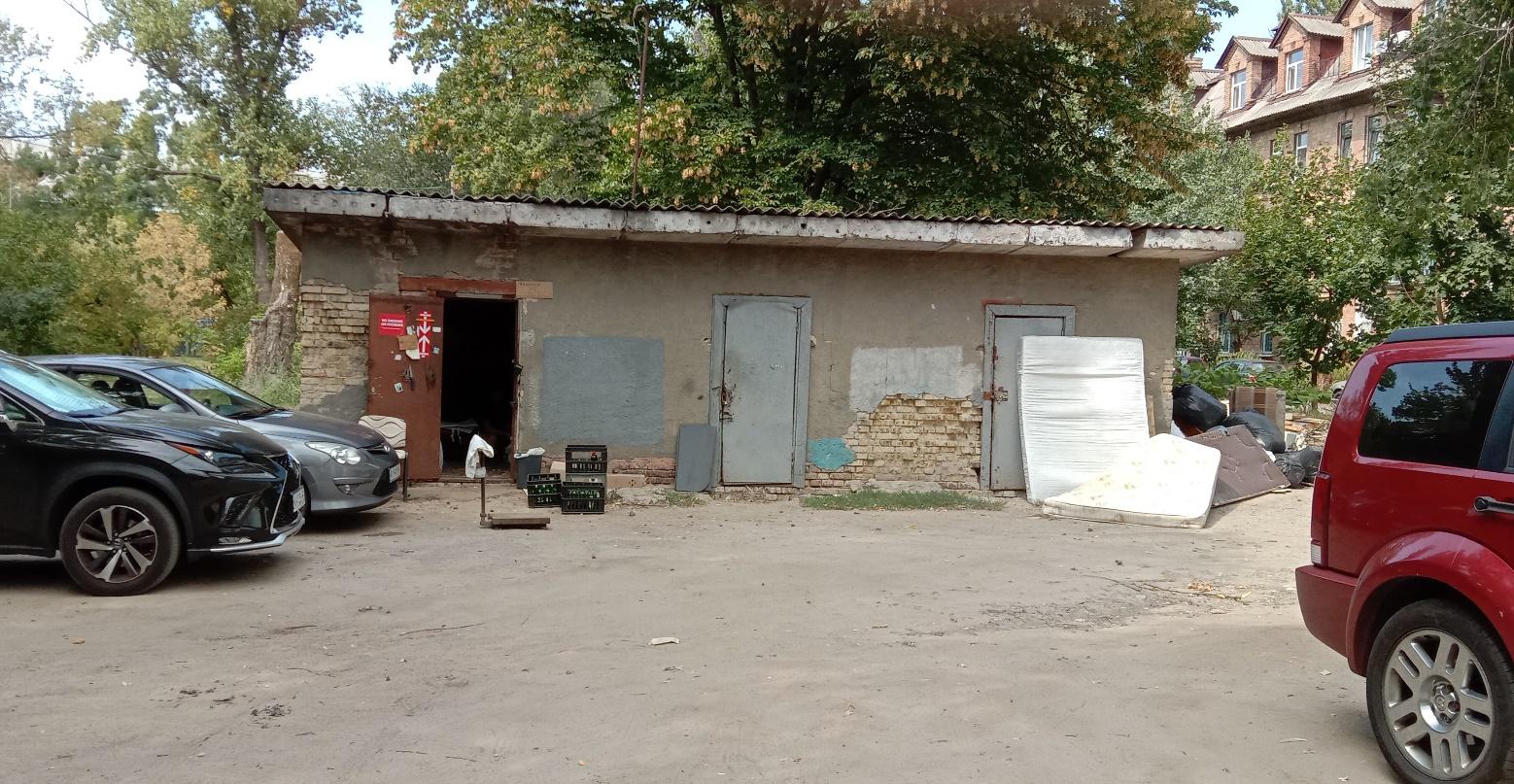
The building in the yards at 6D Kateryna Bilokur Street
The court ruling shows that BTI.CENTER LLC produced a technical passport, according to which there is a public building with an area of 193 square meters on this plot. A private notary, based on this technical inventory alone, registers an individual’s ownership of the ghost building. This person then establishes APARTBUDGROUP LLC and contributes the ownership to its authorized capital. A few days later, the company is re-registered to the new owner.
No official is involved in the fraud. The new owner and manager of the company are also de jure, unrelated to the fraud. The company has officially recognized by the state ownership of a building that never existed. This ownership allows them to obtain a land plot for the construction of a residential building in the central district of Kyiv without a tender.
How do you pull it off without framing officials or prematurely exposing the deal? To develop a land management project, you first need permission from the authorities. If the land is communal, it is the local council.
If you own a building, tacit consent will help. That is, it is okay if they do not give you permission or refuse you within a month. And the local council does not work that fast. To be safe, you can submit an application before the summer or winter vacation. You can also arrange with the executive bodies or the council’s land commission to slow down.

10 years ago, the Kyiv City Council allowed individuals to develop a project for the land plots they use at their own expense. It was used on Kateryna Bilokur Street.
Next, a targeted program was approved, which provides for the allocation of UAH 1.3 billion from the budget for the development of land management projects within the inventory in 2022-2025. This is how projects are developed at the expense of the budget for further “toilet scheme” deals for both elected officials and simply interested parties with relevant connections in the Kyiv City Council and Kyiv City State Administration.
It is easy to hide such deals among the general inventory – they come in a package with the approval of land management projects for hundreds of plots, and many such decisions can be made at one meeting. For example, last year, on December 12, the Kyiv City Council considered 44 decisions on land inventory at once, which is documentation for thousands (!) of plots. Of course, such volumes of information are not physically analyzed, so they vote blindly.
In many cases, land surveyors are accused of falsifying land management projects. However, this is not always the case. For example, in the story of Kateryna Bilokur Street, the cadastral plan in the cadastral extract does not contain a fictitious public building – it only shows a five times smaller janitorial building.
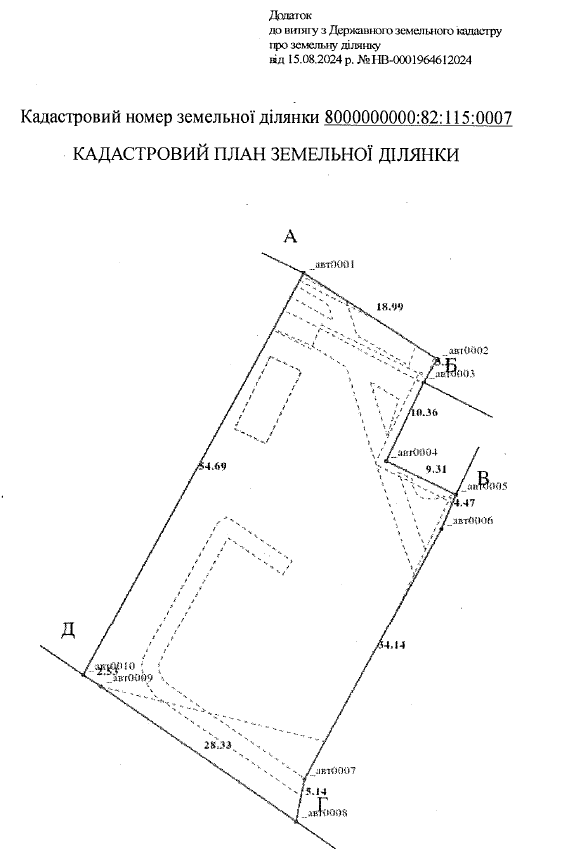
The cadastral plan of the plot at 6D Kateryna Bilokur Street in the extract from the State Land Register
If the beneficiaries want to play it safe, the virtual building can easily become a real one. As already mentioned, the ownership of a building allows for reconstruction within its foundations. However, even reconstruction is not necessary – it is enough to take advantage of deregulation in construction and quickly carry out a “major overhaul” that will result in a hastily constructed foam concrete model. When the building comes into existence, it will be much safer and cheaper to pull off a subsequent land acquisition deal, as the risk of the contractors becomes minimal.
It is important that the approval of the land management project is now as simple as possible, so there are no problems with passing it and then registering the land plot in the State Land Cadastre. Even if the project is falsified, it is easy for officials to “ignore” the absence of a building with impunity – the law does not provide for any surveys of the site either during the approval of the land management project or during its registration in the State Land Cadastre.
There is no building, there is a draft decision to transfer the land plot, and the officials are not to blame? We have a “state in a smartphone,” and the authorities live in this virtual reality.
The technical passport for a non-existent building is in the Unified State Electronic System in the field of construction. Ownership is in the State Register of Real Estate Rights. The land management project is in the State Land Cadastre. All of these documents were created by private individuals freely chosen by a person interested in the transaction.
However, all of these documents are, by definition, considered reliable and recognized by the state, as they are contained in the relevant state registers. In the case of further administrative services based on them, officials should not question them and should not necessarily take any action to verify the accuracy of the information.
This does not mean that someone can deceive the officials themselves and make a deal without huge connections or bribes. The absence of an obligation does not mean that everything is not checked. It only means that it is possible to hide the results of the inspection with impunity.
For example, in the case of Kateryna Bilokur Street, a representative of the Territorial Control Department of the Kyiv City State Administration inspected the site. The explanatory note states that he found “a building that has signs of capital construction.”
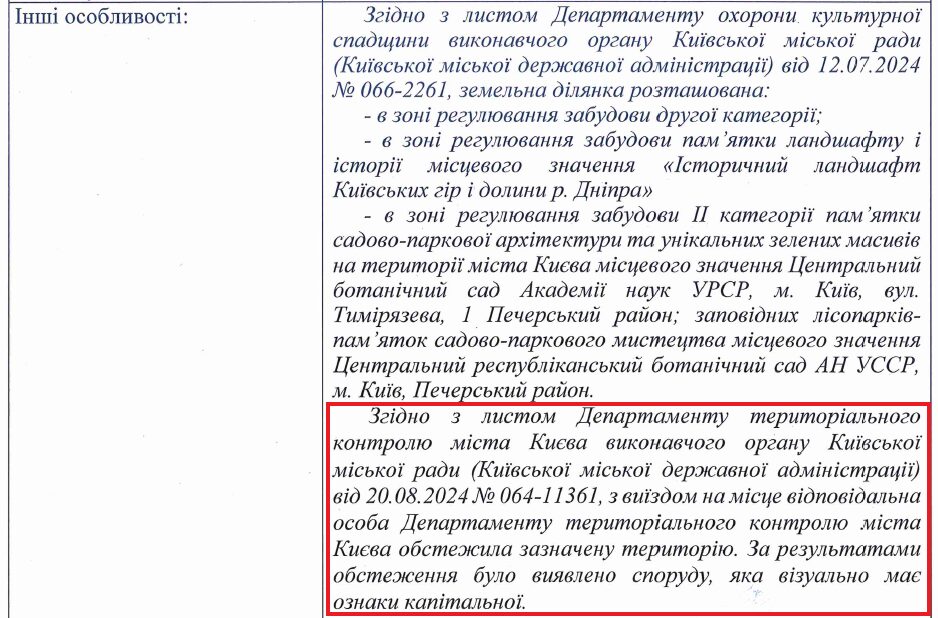
Fragment of the explanatory note to the project of land allocation at 6D Kateryna Bilokur Street
Is it possible to confuse a 40-square-meter janitorial equipment booth with a public building of about 200 square meters during the inspection? Of course not.
Yet, is it possible to accuse the department official who conducted the corruption inspection on the basis of these documents? No, because they did not write that there was a fictitious public building on the site. And they are not obliged to write that there is no such public building on the site – they cannot even be accused of criminal negligence, although everyone understands their role.

The last step in the fraud is to get a land allotment for a non-existent building through the local council so that it does not catch the eye and the deputies cannot be accused of corruption.
The law does not set specific requirements for local councils to consider land allocation issues. However, these requirements are usually set by the councils themselves in their own Regulations and Procedures for consideration of land issues.
Fraud with non-existent real estate when obtaining land in Kyiv has surfaced before, but the bigger problem was the legalization of unauthorized construction. Deputies have repeatedly voted to allocate plots of land for the operation of old buildings that no longer existed, and in their place were illegally built high-rise buildings.
The Kyiv City Council Regulations, in force since 2014, required that consideration of land transfer projects be accompanied by a demonstration of “photographic documentation of its actual condition,” but only outdated satellite images were shown.
To solve the problem, in 2017, the Procedure for Acquiring Land Rights in Kyiv provided for the mandatory addition to the cadastral file of satellite imagery of a land plot taken no later than one year and actual photographic documentation taken no later than thirty calendar days before the day of registration of the draft decision.
Establishing clear requirements for the time of photo fixation was supposed to finally stop fraud, but these requirements have never been met by the Kyiv City Council. They are not enforced regardless of the presence or absence of fictitious buildings because the leaves are hidden in the forest.
We will demonstrate how this looks in practice using the already mentioned project, a virtual building on Kateryna Bilokur Street.
The Kyiv City Council Regulations stipulate that the draft decision on land relations must be accompanied by aerial photography and photographic documentation of the actual state of use of the relevant land plot (Article 26). However, the annexes contain only satellite imagery.
Despite the obvious violation of the Regulations, on the day of registration, Kyiv City Council Secretary Volodymyr Bondarenko sent the draft to the commission for consideration.
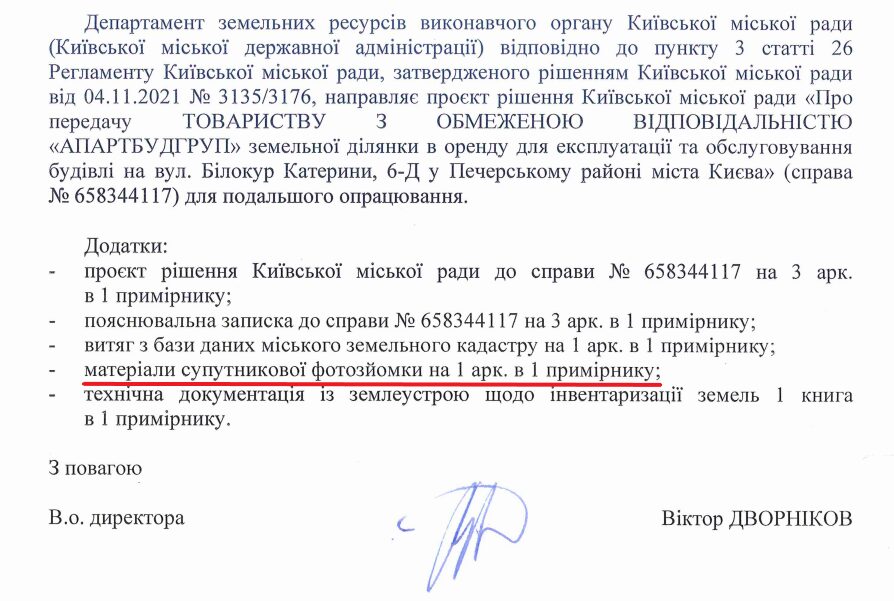
Cover letter to the project with a list of attached documents
Such violations always occur. To make them less obvious, the Regulation provides for the concealment of photographic documentation of the actual state of use of the land plot from the public – only aerial photographs are subject to publication on the Kyiv City Council website (Article 29).
Perhaps satellite imagery could replace photographic documentation of the actual state of the site if it were of high quality and sufficiently new. However, the draft decision includes low-quality photos taken in 2019 (!).
Kyiv is a big city: neither deputies nor activists can check several hundred plots that are usually allocated at each meeting.
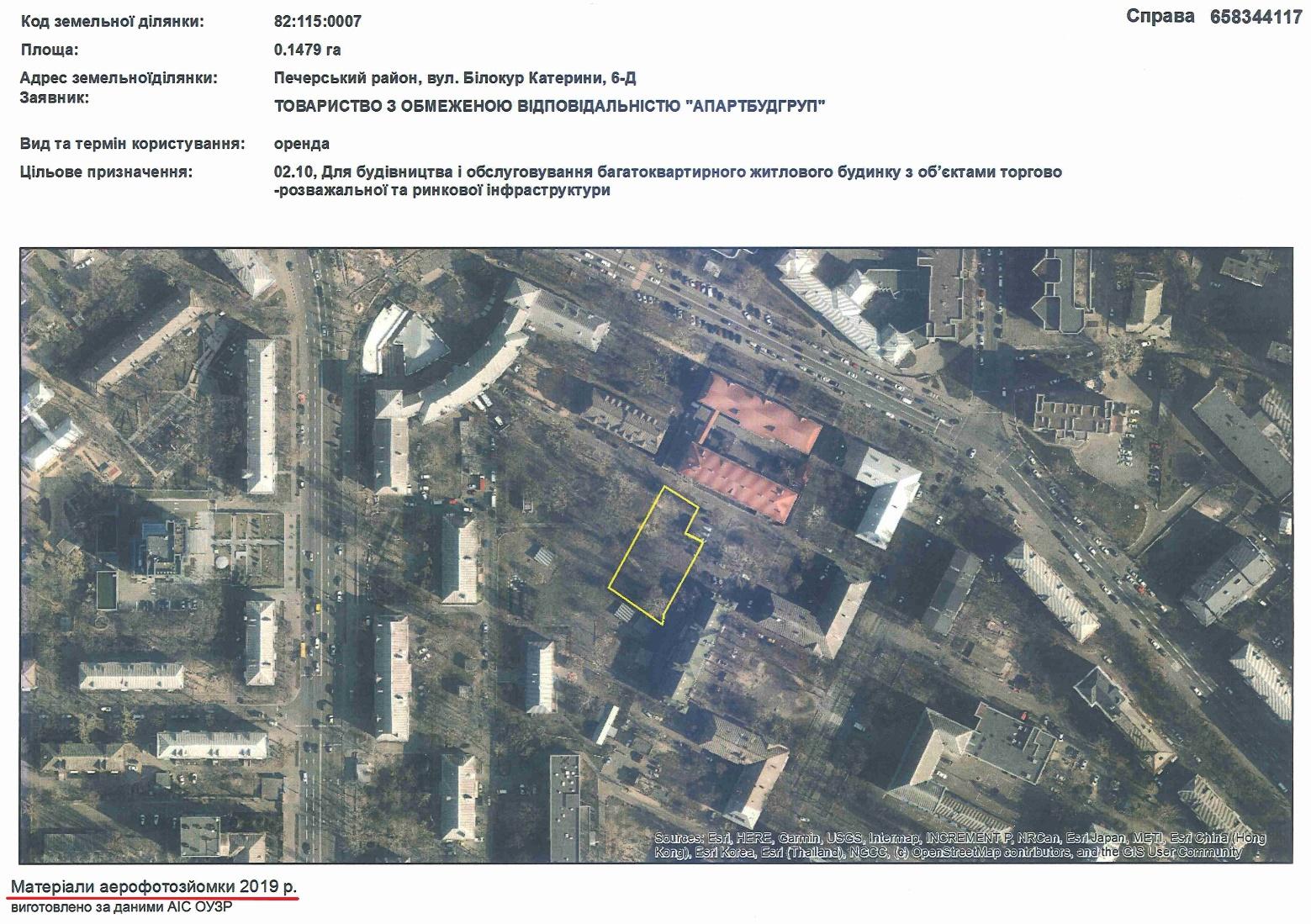
Graphic materials from the draft decision on the allocation of the plot in 2024
However, the Kyiv City Council Regulations contain another safeguard that should level all this: consideration of land projects should be accompanied by a demonstration of the location of the plot, aerial photography, and photographic documentation of its actual condition (Article 37).
However, no photos of the actual condition of the land plot are ever shown. The deputies see the same slide on the screen as in the picture. It is impossible to determine what is happening at the site and what is there from a photo of this quality and one that was taken 5-6 years ago. Of course, ordinary Kyiv residents watching the Kyiv City Council meetings can only notice fraud if it is about a plot they know well.
If the Kyiv City Council simply complied with the requirements of its Regulations and the Procedure for Acquiring Land Rights, stories like the latest Komarnitsky and Co. case would be almost impossible, as it would be impossible to hide the violations. The main question is: who should control compliance with the Regulations? These are the presiding mayor, Klitschko or secretary Bondarenko, as well as the regulatory commission, where the majority are representatives of the European Solidarity faction.
It appears all factions are satisfied with the violations. The Rules of Procedure provide for a review of the voting results if there were violations during the consideration (Article 37). If every deputy declares a violation of the Rules of Procedure during the consideration of each of the several hundred land issues at the meeting, this will gently force the Kyiv City Council leadership to start working without violations. Yet, there are no such deputies.

Reforms in the land sector are carried out under the slogan of fighting corruption. However, they only involve extortion of bribes. Therefore, the reforms are moving towards deregulation and decentralization.
Bribe extortion has decreased, but it has not yet been overcome — the local council still votes to determine the final tie-breaker, and in many cases, it is necessary to negotiate with the deputies.
However, another type of corruption is gaining momentum – the adoption of deliberately illegal decisions in the interests of certain individuals.
Legislation is full of legal uncertainties and discretionary powers, which remove responsibility from government officials. Where guilt can be proven, public services are provided by private entities.
Is it corruption if technical supervision engineers, private notaries, and land surveyors violate the law in the interests of certain individuals? Yes, because such violations by private individuals providing public services constitute corruption under the Law on Prevention of Corruption.
But there is a nuance – corruption committed by such persons is not under the jurisdiction of the NABU.
It seems that the land sector was deliberately reformed to make it as difficult as possible for NABU to work in this area. So here we are: in the Komarnytsky case, certain officials were caught, and there is a high-profile case of corruption in the Kyiv City Council and Kyiv City State Administration. But in the situation on Kateryna Bilokur Street, which is absolutely identical in terms of the set of violations, no officials were caught red-handed, and, therefore, there seems to be no corruption, and the police are investigating a trivial case of fraud by a private company.

The reasons for the problem are known and outlined in the article above – the Verkhovna Rada can easily patch up all the holes. Another question is whether the government has the political will to do so. After all, even a high-profile NABU case can only be used to accuse local Kyiv authorities of corruption and leave the scheme created by law untouched in their own interests.
However, the Kyiv City Council can do its part easily – it is enough to stop violating its own Regulations and Procedures for resolving land issues.
Specially for “Dzerkalo Tyzhnia”