
Why didn’t the anti-corruption barriers work? The President signed the controversial bill No. 9627

President Volodymyr Zelensky, in an interview with Fox News a few weeks ago, convincingly stated that there is “nothing corrupt” in our country and even during wartime, “complex anti-corruption reforms” are being carried out.
However, last week he began by signing the controversial bill No. 9627, which simplifies the procedure for changing the purpose of agricultural land to industrial to attract investment for the rapid reconstruction of Ukraine, authored by Dmytro Kysilevskyi (“Servant of the People”). The public sector had warned about the corruption and problematic nature of this document both before the first reading and before its adoption as a whole. A similar initiative a year ago was attempted to be pushed through parliament by the deputy head of the president’s office, former Regions Party member Rostyslav Shurma.
The anti-corruption reforms that Zelensky spoke of do exist, and they are about systematic anti-corruption efforts. Under pressure from Western partners, in 2022, the Anti-Corruption Strategy was finally adopted, which had been gathering dust in the Verkhovna Rada for almost two years, although Zelensky had deemed it urgent. And in March 2023, the government approved the State Anti-Corruption Program.
Both the Anti-Corruption Strategy and the program were supposed to prevent the adoption and signing by the president of such a bill as No. 9627. However, it became law in the end.
Therefore, this example should be analyzed for society and Western partners to understand how corruption-prone legislation manages to bypass supposedly successful and complex anti-corruption safeguards.

The bill allows, in the absence of urban planning documentation during wartime and within five years after its cancellation, to change the designated purpose of land plots, primarily agricultural, outside settlements for the construction of industrial facilities.
The consequences of this are catastrophic:
- Community members are deprived of the right to influence the placement of environmentally hazardous facilities on the community’s territory;
- The strategic environmental assessment, which was introduced in 2018 as part of the implementation of Directive 2001/42/EC of the European Parliament and of the Council, has been canceled.
This legislative initiative, like the urban planning “reform” #5655, was carried out under the slogan of fighting corruption hindering investment.
However, corruption in land use change legislation has not disappeared. What happened? The implementation of corrupt schemes has been significantly simplified. The relevant body of the executive committee of the local council ensures the development of urban planning documentation. All violations in urban planning documentation occur at this stage, often involving corruption. Only now, under public pressure, the local council can refuse to approve this documentation, but the new bill removes the local council from this approval process. The executive committee will now decide everything on its own.
One might say that now officials preparing these documents will not bear personal responsibility, but such responsibility exists even without #9627. Recall the recent case of the Deputy Head of the Kyiv City State Administration, who was suspected by the National Anti-Corruption Bureau for preparing and submitting to the Kyiv City Council one of the land allocation projects.
Under the new law, the decision to allow or disallow will be made manually by officials of the executive committees of local councils, rather than by the council itself through voting, and without mandatory public hearings and an assessment of environmental consequences.
Indeed, this bill contains corruption-prone factors, as do many other laws passed by the Verkhovna Rada. However, in this case, it is about a law that violates the new anti-corruption barriers of the reform that the president boasted about. So why didn’t they work?
To prevent bills with corruption risks from being adopted, the state developed anti-corruption barriers.

“Free of charge procedures for changing the designated purpose of land plots stimulate corruption when making relevant decisions,” – this conclusion was approved by the constitutional majority of the Verkhovna Rada in June 2022 (problem 3.5.6 to be addressed by the Anti-Corruption Strategy).
And the language in the Anti-Corruption Strategy is not just about changing the designated purpose of agricultural land. It is about changing the designated purpose of land of all categories regardless of No. 9627.
For understanding, an acre of agricultural land costs $1-2 thousand USD, and after changing the designated purpose to industrial land, depending on the location, its price will increase by dozens or even hundreds of times.
In populated areas, the relative increase in price when changing the designated purpose of land may not be so significant, but the absolute increase ranges from hundreds of thousands to several million dollars per hectare near the centers of large cities.
The existing procedure for changing the designated purpose of land creates insane profits “out of thin air” for interested parties. And these interested parties are eager to share part of this profit with responsible government representatives.
But only “their” investors-builders can get cheap land through bribery. In Ukraine, there has long been a separate shadow business in this process. Persons close to the authorities buy cheap land, change its designated purpose through corrupt schemes, and then sell expensive land for development to real investors.
The only way to defeat a corruption scheme with such profitability is to deprive it of this profitability.
All this has long been known to our Western partners. In 2018, conclusions were voiced by foreign experts involved by the German Society for International Cooperation (GIZ): without establishing compensation for the price difference when changing the designated purpose of land, it is impossible in Ukraine to overcome corruption in this area or ensure normal urban development.
It would seem that everything should be obvious from here: the main reason for the existence of corruption when changing the designated purpose of land has been identified and officially recognized by the Verkhovna Rada, so it remains only to eliminate this reason.
However, in the Anti-Corruption Strategy, the problem is identified, but its solution is not provided for.
The initial version of the strategy envisaged making it mandatory to pay to the budget the price difference for the land plot before and after changing its designated purpose mandatory for the budget, and for particularly valuable land – in the amount of this difference multiplied by five.
However, the solution to the problem of corruption in such an important matter was removed from the Anti-Corruption Strategy by the second reading. The relevant amendment (No. 453) was submitted back in 2021 by the then First Deputy Chairman, and now Chairman of the Verkhovna Rada, Ruslan Stefanchuk.

Comparative table of the Anti-Corruption Strategy before the second reading
Stefanchuk’s argument: Law No. 711-IX recently amended Article 207 of the Land Code with a new Part Six, which provides for compensation, but not in full, but at a rate of 30% of the price difference, and not for all cases, but only when changing the purpose of agricultural land.
So to speak, something was done in this direction, but good things need to be done gradually so that there is still corruption left for future generations to fight.
By the way, the provision in the Land Code, which Stefanchuk justified his proposals with, was repealed just four months after the adoption of the Anti-Corruption Strategy. Their own positive reform was rolled back quietly – unnoticed by an amendment by MP Alexander Haydu from the “Servant of the People” party in Bill No. 7636 before the second reading.
Conclusion one. In the midst of war, the authorities decided not to fight corruption in certain areas, creating holes in the final version of the main strategic anti-corruption document before its adoption in 2022.
As early as 2020, the Verkhovna Rada knew both the root cause of rampant corruption in changing the purpose of land and the best way to combat this corruption by removing the economic benefit from such schemes.
At the same time, the path laid down in the first draft of the Anti-Corruption Strategy envisaged redirecting profits to local budgets, which now, thanks to corrupt schemes, end up in the pockets of certain individuals close to local authorities. And we are talking about significant revenues to the budgets – the author of Bill No. 9627, Dmytro Kysylevsky, claims that billions of hryvnias a year were paid only in bribes, so the total profit of the shadow business from existing corruption schemes in changing the purpose should amount to tens of billions per year.
But, at the suggestion of the head of the Verkhovna Rada Ruslan Stefanchuk, the MPs decided to leave everything as it is.
If the Anti-Corruption Strategy had not only contained the cause of corruption in changing the purpose of land but also proposed a way to overcome this corruption from the outset, the Verkhovna Rada would not have even started its schemes with Kysylevsky’s bill.

As noted earlier, the bill provides for simplifying the procedure for changing the land use designation in the absence of urban planning documentation.
The State Anti-Corruption Program contains five interconnected measures aimed at effectively preventing such legislative changes.
The measure in Appendix 2 (2.5.6.1.7) involves continuous monitoring of bills to identify attempts to abolish the development of comprehensive plans and, based on this, determine the functional zoning of territories, restrictions on land use as mandatory prerequisites for establishing and changing the land use designation of land plots.
The subsequent measures (from 2.5.6.1.8 to 2.5.6.1.11) establish a list of actions to be taken in the event of such bills, from submitting comments to prevent adoption to appealing to the president to exercise the veto right if such a law is adopted.

Measures 2.5.6.1.7–2.5.6.1.11 of the State Anti-Corruption Program.

But how could one violate the State Anti-Corruption Program and not get caught when we have the best monitoring system in the world for its implementation, and analysts from the National Anti-Corruption Prevention Agency review everything quarterly?
Bill No. 9627 was introduced to the Verkhovna Rada in the third quarter of last year and was passed in the first reading in the fourth quarter. All of this should have already been reflected in the results of two monitoring periods, and everyone interested should have seen only complete and objective information in the public system.
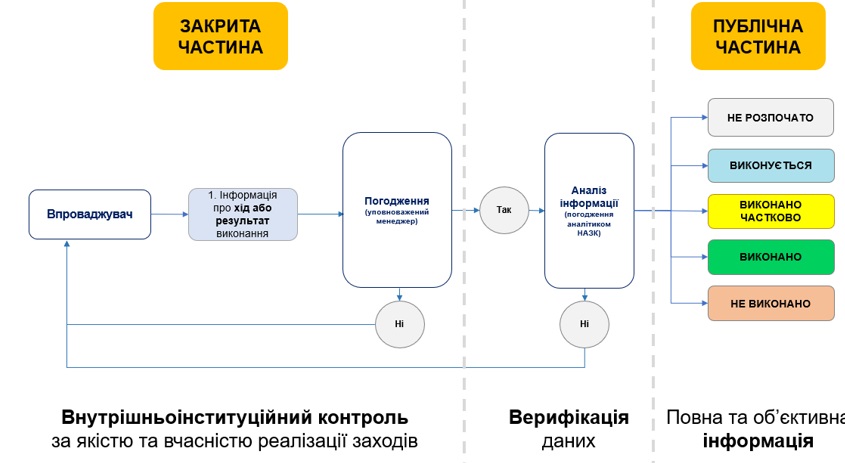
Official scheme of the monitoring procedure for the implementation of the State Anti-Corruption Program
However, according to the monitoring system of the State Anti-Corruption Program, everything is fine with measures 2.5.6.1.7–2.5.6.1.11.
The execution of the first step in the chain, 2.5.6.1.7, is proceeding smoothly. As of January 31, 2024, “progress in implementing the measure is available”.
The official, NAZK-verified result is as follows: “According to the information from the Ministry of Agrarian Policy and Food, based on the results of the monitoring conducted, no draft laws have been identified that envisage amendments to the Land Code of Ukraine regarding the abolition of the development of comprehensive plans for spatial development of the territory of territorial communities and the determination, based on this, of the functional zoning of territories, restrictions on land use as mandatory prerequisites for establishing and changing the purpose of land plots.”
The Ministry of Agrarian Policy and Food actively participates in the development of the draft law, which contradicts the State Anti-Corruption Program. Then it openly and publicly supports it instead of taking all possible measures to prevent its adoption.
However, according to NAZK, no such draft laws have been identified. And NAZK, which was supposed to monitor and verify all this, confirms the implementation of the State Anti-Corruption Program by the Ministry of Agrarian Policy and Food.
It is clear that the next related measures, 2.5.6.1.8–2.5.6.1.11, have not even started to be implemented because there are officially no draft laws that they should obstruct.

Information from the monitoring system of the State Anti-Corruption Program regarding the implementation of measures 2.5.6.1.7–2.5.6.1.11.
The third conclusion that can be drawn here is that the widely publicized monitoring of the implementation of the State Anti-Corruption Program, which was supposed to ensure the implementation of anti-corruption measures, is a fiction.
The National Agency for Prevention of Corruption, at best, takes the word of the implementers and does not verify anything. In the worst case scenario, the NAPC deliberately turns a blind eye and conceals violations of the State Anti-Corruption Program, introducing knowingly unreliable information into the monitoring system for its implementation.

President of Ukraine himself won’t have time to delve into what the Verkhovna Rada has adopted before leaving his autograph on a law or a veto decision. He physically doesn’t have time for that.
But the king plays by honor. And Volodymyr Zelensky personally chose his environment in the form of the president’s office under the leadership of Andriy Yermak, who in turn chose his deputies. And one of them is Rostyslav Shurma, who is either dealing with “Forests of Ukraine” or paying attention to “Water of Ukraine,” or showing interest in agricultural land.
It’s no secret that there are special people on Bankova Street who study every new law and information about it in the media, after which a short report is prepared with a list of possible negative consequences for the president’s reputation in case of signing.
We can only guess whether Zelensky was aware of the problems with draft law No. 9627 and deliberately decided that such risks for his reputation in the midst of the war were acceptable. Or perhaps Yermak’s subordinates confidently told him that everything was fine with the new law.
But there is a fact: a law that does not address the problems of the Anti-Corruption Strategy and directly contradicts the State Anti-Corruption Program was signed by the President of Ukraine.
The fourth conclusion that suggests itself here is: for officials, it doesn’t matter whether Volodymyr Zelensky signed the scandalous law knowingly or unknowingly, developed in violation of anti-corruption measures. They will make the same conclusion in advance: it is possible to directly violate the State Anti-Corruption Program, the president doesn’t mind.
We successfully fight our imperial past, but we decided to leave the method of “Potemkin villages” as our legacy. However, they are being built not for Moscow kings now but for our Western partners, to convince them of successes on the anti-corruption front.
You can close your eyes to not see corruption and then confidently say that “everything is clean.” Similarly, you can confidently talk about complex anti-corruption reforms, ignoring their effectiveness.
But corrupt laws are like a needle in a haystack, which will come out at the most inconvenient moment.
And most importantly. Should we expect real success if the biggest anti-corruption reforms turn out to be just decorations up close?
Specially for “Mirror of the Week“